But what if the princess was in the tower because she was the dragon?
Like the queen gives birth and oops it’s this adorable little scaley lizard with tiny wings that she can never quite seem to fold right
None of the King’s advisors or doctors can explain it, no one can remember anyone who might have cursed the royal family, plus sire she’s clearly yours still I mean look at those eyes
They just kind of accept it and keep her in a tower so no one tries to slay her
The queen or castle servants reading bedtime stories to the toddler princess, who’s made a nest of her favorite toys and some jewelery she stole off her mother, and when she laughs little puffs of smoke come out of her mouth
The king being so proud when she flies across the room for the first time
And once the princess comes of age, confused knights breaking into the tower to find a twenty foot long dragon sitting at the vanity getting her horns polished by her handmaidens
and the “kidnapped” princess is her girlfriend?
this feels like a minotaur myth gone amazingly right.
Okay, who brought this back? Because I haven’t seen notes on this thing in literally months.
Posted on
Posted on
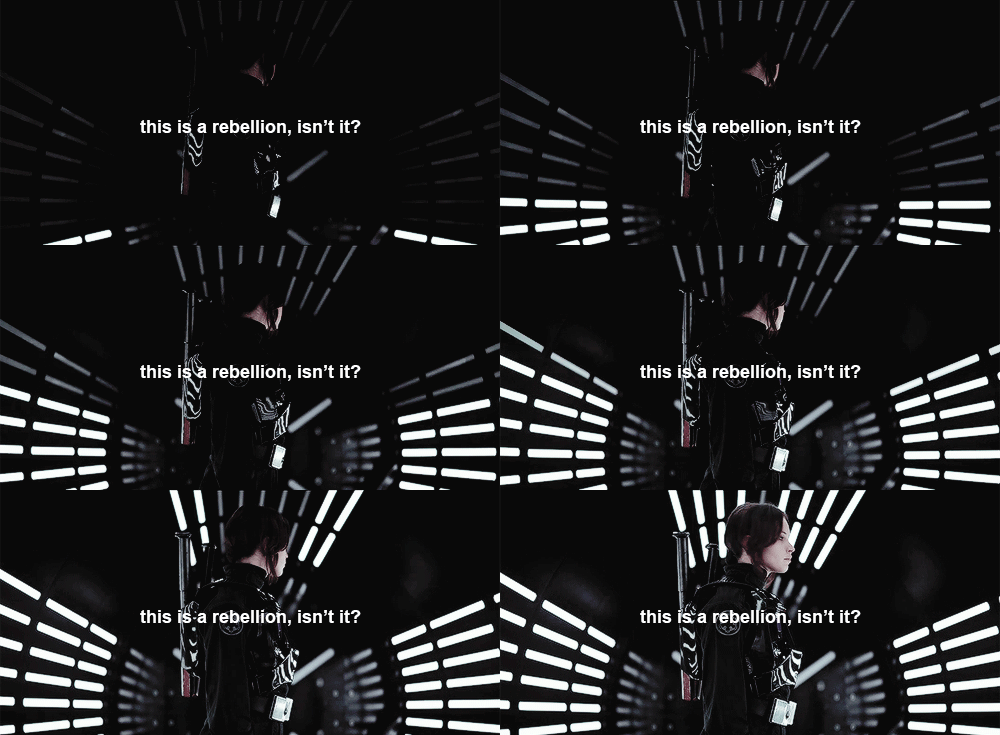
We’ve got your Death Star plans right here, and there’s not a damn thing you can do about it. I can only imagine how frustrating it must be to realize just how much the plot of your favorite movie hinges on the actions of one woman (accompanied by a team full of dudes anyway). I guess it’s kind of like realizing that the name of your men’s rights movement is wholesale stolen from a movie written by two trans women. Oh, the irony. But I digress.
You see, we’ve got more than just your Death Star plans. What we have is this realization that these worlds—these rich, fantastic fantasy/sci-fi/everything worlds—don’t just belong to you anymore. They never really only belonged to you. They belonged to all of us, and always have, despite how hard you’ve tried to erase us from the narrative.
being emotionally abused has made me incredibly defensive towards being told what to do, but at the same time has made it hard for me to do things without someone telling me that it’s ok to do out if fear of doing something wrong and getting in trouble
This is for all the unsung fic writers; the ones who don’t make the must-read lists, the ones who don’t get recced, the ones who don’t get hundreds of kudos, the rarepair writers out on the peripheries of fandom, the ones who toil away quietly for the handful of people who read and love them. You matter – you’re a writer too, and don’t you ever forget it. 🙂
Posted on
The trap of the two-woman love triangle is not one that Hamilton entirely avoids. Angelica and Eliza fall neatly into the old conventional/rebellious dichotomy. Angelica, who stands center stage as she raps, “I’ve been reading Common Sense by Thomas Paine / So men say that I’m intense or I’m insane,” is the rebellious one. Eliza, who has, she tells us, “never been the type to try and grab the spotlight,” is the conventionally feminine one. And because Angelica and Eliza are the only major female characters in the show — Peggy Schuyler and Maria Reynolds, the other two female singing parts, have one song apiece — they stand in for all women. Angelica is not just an intellectual woman in the way that Hamilton and Jefferson are intellectual men; she is the intellectual woman. Eliza is not just a domestic woman but the domestic woman.
But Hamilton does depart from the typical love triangle structure when it comes time to designate one of the women as good and the other as bad. The show has no interest in doing so, and it can be shocking to realize this. Watching Hamilton for the first time it is easy to anticipate, as Als does in his New Yorker review, that because Eliza is “genteel” she must be “therefore dull,” or that because Angelica is politically intelligent she must be angry and shrill, as Noonan is pleasantly surprised to find she is not. Instead, Hamilton treats both its women with respect and admiration. It operates on the assumption that both of these characters are important, that the different ways they perform femininity are valid, and that their contributions to history are valuable.
*What makes Hamilton unique is that it recognizes the tragedy in both women’s lives*
Hamilton recognizes that in the 18th century, both rebellious and conventionally feminine women are trapped. Angelica has the intellect and the drive to make valuable contributions to the emerging republic, but instead she is stuck behind the scenes, “a girl in a world in which / my only job is to marry rich.” Her refrain throughout the show is, “I will never be satisfied,” because it is her tragedy to live in a world where she cannot do the kind of work that would satisfy her. In contrast, Eliza has the opportunity and means to do the kind of domestic work that she loves and is good at, but she lives in a world where this kind of work is not valued, because it’s considered less important than the political work Hamilton does. Eliza is stuck at the fringes of history, whispering, “Oh, let me be a part of the narrative,” and her refrain is, “That would be enough,” because it is her tragedy to live in a world where she is denied the little respect she asks for.
And Hamilton gives both Angelica and Eliza the space onstage to examine their tragedies. Angelica’s “Satisfied” is widely considered to be one of the best songs in the show — Rolling Stone calls it Hamilton’s “finest moment” — and the musical ends with Eliza in the spotlight and center stage, declaring, “I put myself back in the narrative.” In the world of Hamilton, Angelica’s plight is worth more musical attention than the Federalist Papers; Eliza’s domestic work and contributions to history are so important they become the focus of the finale. Neither of the two women is “bad” or “lesser.”
THIS is when the Doctor loses Rose. It’s the biggest emotional reaction we’ve ever get from him to this point. Occasionally you saw him cry, but if you look at them, most of the time it’s not because of an other person. Like in Human Nature..it’s because he knows he’s going to die.. exactly like in EoT. But this..this is for his Rose. He loved her and now she’s gone.
And now look at this:
THIS ..the man who just died in his arms, had tortured him for a year, killed a major part of humanity and was utterly insane. And the Doctor …he doesn’t just cry…he breaks.. I know people say it’s because he had hope to not be alone anymore, but he had been alone for many years…this is more.. Russel said The Master loved him, but with this scene…you know… You know that the Doctor doesn’t care what the Master had done to him, he loves him with all his hearts and this is the face of a man loosing everything…
And this is ladies and gentlemen one of my reasons why they are my OTP.