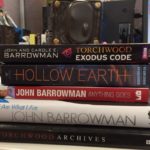
I was tagged by ladysaucebox and it’s books, so sure:

In a text post, list ten books that have stayed with you in some way. Don’t take but a few minutes, and don’t think too hard — they don’t have to be the “right” or “great” works, just the ones that have touched you. Tag [ten] friends, including me, so I’ll see your list. Make sure you let your friends know you’ve tagged them

  1. Ender’s Game – Orson Scott Card
  2. Canticle for Leibowitz – Walter M Miller
  3. The Crystal Cave Trilogy – Mary Stewart
  4. Trask – Don Berry
  5. Time Enough for Love – Robert Heinlein
  6. Imzadi – Peter David
  7. The illustrated Man – Ray Bradbury
  8. Les Miserables – Victor Hugo
  9. The Ship who Sang – Anne McCaffery
  10. The Outline of History – HG Wells

(I could have listed more Heinlein, Card and Bradbury stories)

I’m going to tag reclusiveq, awabubbles, jazzforthecaptain, type40consultingdetective, willietheplaidjacket, willow555, practicefortheheart, aquart1999, amalgamads, amphigoricsymphony
Cross out what you’ve already read. Six is the average.

Pride and Prejudice – Jane Austen
Lord of the Rings – JRR Tolkien
Jane Eyre – Charlotte Bronte
Harry Potter series – JK Rowling
To Kill a Mockingbird – Harper Lee
The Bible – Council of Nicea 
Wuthering Heights – Emily Bronte 
Nineteen Eighty Four – George Orwell
His Dark Materials – Philip Pullman
Great Expectations – Charles Dickens
Little Women – Louisa M Alcott
Tess of the D’Urbervilles – Thomas Hardy
Catch 22 – Joseph Heller
Rebecca – Daphne Du Maurier
The Hobbit – JRR Tolkien
Birdsong – Sebastian Faulk
Catcher in the Rye – JD Salinger
The Time Traveller’s Wife – Audrey Niffenegger
Middlemarch – George Eliot
Gone With The Wind – Margaret Mitchell
The Great Gatsby – F Scott Fitzgerald
Bleak House – Charles Dickens
War and Peace – Leo Tolstoy
The Hitch Hiker’s Guide to the Galaxy – Douglas Adams
Brideshead Revisited – Evelyn Waugh
Crime and Punishment – Fyodor Dostoyevsky
Grapes of Wrath – John Steinbeck
Alice in Wonderland – Lewis Carroll
The Wind in the Willows – Kenneth Grahame
Anna Karenina – Leo Tolstoy
David Copperfield – Charles Dickens
Chronicles of Narnia – CS Lewis
Emma – Jane Austen
Persuasion – Jane Austen
The Lion, The Witch and The Wardrobe – CS Lewis
The Kite Runner – Khaled Hosseini
Captain Corelli’s Mandolin – Louis De Bernieres
Memoirs of a Geisha – Arthur Golden
Winnie the Pooh – AA Milne
Animal Farm – George Orwell
The Da Vinci Code – Dan Brown
One Hundred Years of Solitude – Gabriel Garcia Marquez
A Prayer for Owen Meaney – John Irving
The Woman in White – Wilkie Collins
Anne of Green Gables – LM Montgomery
Far From The Madding Crowd – Thomas Hardy
The Handmaid’s Tale – Margaret Atwood
Lord of the Flies – William Golding
Atonement – Ian McEwan
Life of Pi – Yann Martel
Dune – Frank Herbert
Cold Comfort Farm – Stella Gibbons
Sense and Sensibility – Jane Austen
A Suitable Boy – Vikram Seth
The Shadow of the Wind – Carlos Ruiz Zafon
A Tale Of Two Cities – Charles Dickens
Brave New World – Aldous Huxley
The Curious Incident of the Dog in the Night-time – Mark Haddon
Love In The Time Of Cholera – Gabriel Garcia Marquez
Of Mice and Men – John Steinbeck
Lolita – Vladimir Nabokov  
The Secret History – Donna Tartt
The Lovely Bones – Alice Sebold 
Count of Monte Cristo – Alexandre Dumas
On The Road – Jack Kerouac
Jude the Obscure – Thomas Hardy
Bridget Jones’s Diary – Helen Fielding
Midnight’s Children – Salman Rushdie 
Moby Dick – Herman Melville
Oliver Twist – Charles Dickens
Dracula – Bram Stoker
The Secret Garden – Frances Hodgson Burnett
Notes From A Small Island – Bill Bryson
Ulysses – James Joyce 
The Bell Jar – Sylvia Plath
Swallows and Amazons – Arthur Ransome
Germinal – Emile Zola
Vanity Fair – William Makepeace Thackeray
Possession – AS Byatt
A Christmas Carol – Charles Dickens
Cloud Atlas – David Mitchell
The Color Purple – Alice Walker
The Remains of the Day – Kazuo Ishiguro
Madame Bovary – Gustave Flaubert
A Fine Balance – Rohinton Mistry
Charlotte’s Web – EB White
The Five People You Meet In Heaven – Mitch Albom
Adventures of Sherlock Holmes – Sir Arthur Conan Doyle
The Faraway Tree Collection – Enid Blyton
Heart of Darkness – Joseph Conrad
The Little Prince – Antoine De Saint-Exupery 
The Wasp Factory – Iain Banks
Watership Down – Richard Adams
A Confederacy of Dunces – John Kennedy Toole 
A Town Like Alice – Nevil Shute
The Three Musketeers – Alexandre Dumas
Hamlet – William Shakespeare
Charlie and the Chocolate Factory – Roald Dahl

I like that library books have secret lives. All those hands that have held them. All those eyes that have read them.

― Neela Vaswani, “Same Sun Here” (via leftinalibrarybook)

Knowing how to read and not reading books is like owning skis and not skiing, owning a board and never riding a wave, or, well, having your favorite sandwich in your hand and not eating it. If you owned a telescope that would open up the entire universe for you would you try to find reason for not looking through it? Because that is exactly what reading is all about; it opens up the universe of humour, of adventure, of romance, of climbing the highest mountain, of diving in the deepest sea.

Chuck Jones (via dduane)

I wouldn’t mind, but splitting children’s books strictly along gender lines is not even good publishing. Just like other successful children’s books, The Hunger Games was not aimed at girls or boys; like JK Rowling, Roald Dahl, Robert Muchamore and others, Collins just wrote great stories, and readers bought them in their millions. Now, Dahl’s Matilda is published with a pink cover, and I have heard one bookseller report seeing a mother snatching a copy from her small son’s hands saying “That’s for girls” as she replaced it on the shelf.

You see, it is not just girls’ ambitions that are being frustrated by the limiting effects of “books for girls”, in which girls’ roles are all passive, domestic and in front of a mirror. Rebecca Davies, who writes the children’s books blog at Independent.co.uk, tells me that she is equally sick of receiving “books which have been commissioned solely for the purpose of ‘getting boys reading’ [and which have] all-male characters and thin, action-based plots.” What we are doing by pigeon-holing children is badly letting them down. And books, above all things, should be available to any child who is interested in them.

Happily, as the literary editor of The Independent on Sunday, there is something that I can do about this. So I promise now that the newspaper and this website will not be reviewing any book which is explicitly aimed at just girls, or just boys. Nor will The Independent’s books section. And nor will the children’s books blog at Independent.co.uk. Any Girls’ Book of Boring Princesses that crosses my desk will go straight into the recycling pile along with every Great Big Book of Snot for Boys. If you are a publisher with enough faith in your new book that you think it will appeal to all children, we’ll be very happy to hear from you. But the next Harry Potter or Katniss Everdeen will not come in glittery pink covers. So we’d thank you not to send us such books at all.