This is definitely one of the must-reads for any intersectional feminist. A bit dated at this point, but still important, it takes a look at the very issues of exclusion that have hindered the feminist movement since abolition days.
2. Stone Butch Blues by Leslie Feinberg
Honestly, this will just be one of the best books you’ll ever read. It’s not only an important queer, feminist book, it’s also just a beautifully told story of struggle and love.
3. Woman, Native, Other by Trinh T. Minh-ha
Minh-ha delivers a full-frontal attack against the notion of erasure as a means of unified feminism. She argues for a feminism that fights against oppression of all kinds, because women all over the world face oppression at the hands of different forces and factors. And she attacks everything that “others” everything non-white or non-Western. It’s bold and awesome and a classic of postcolonial feminist theory.
4. Assata by Assata Shakur
Assata is part memoir of the radical awakening of a young black woman in the ‘60s and ‘70s, part personal testimony of a broken, racist justice system. In all its parts it’s a lyrical, addictive read that immerses you in one of the most important eras in the Black liberation struggle. By the end you’ll be outraged, angry, and itching for revolution.
5. Random Family by Adrian LeBlanc
Adrian LeBlanc took a lot of care with this book. Working over 10 years and forming close relationships with the families she writes about, LeBlanc offers up an intimate portrait of the lives of two women in a social class that often goes overlooked or misrepresented in popular U.S. culture and scholarly study. It’s importance is in the deeply personal rather treatment, rather than the almost zoological portrayals that often befall lower economic classes.
6. Sex Workers Unite! A History of the Movement from Stonewall to Slutwalk by Melinda Chateauvert
Sex workers are often cast as unwilling victims. Melinda Chateauvert challenges this portrayal by showing that many sex workers are in fact empowered, legitimate workers and have been powerful agents of social change throughout history. This book will make you rethink everything you thought you knew about sex work.
7. The Sacred Hoop: Recovering the Feminine in American Indian Traditions by Paula Gunn Allen
An oldie but a goodie, The Sacred Hoop is a corrective on the crucial role of indigenous women in history and tribal tradition. It’s not a perfect book, but it’s an important one that asserts the presence of Native American women.
8. This Bridge Called My Back by Cherríe Moraga and Gloria Anzaldúa
This anthology is incredible! It’s got essays, interviews, poetry, and even visual art from women of so many different backgrounds. It’s kind of what intersectional feminism should look like in book form. Or, at least, darn close to it.
9. Women and Gender in Islam by Leila Ahmed
Need to check your assumptions about Islam and the treatment of women in the Middle East? Leila Ahmed’s book is an invitation to do just that. So many stereotypes and assumptions about Muslim women and their treatment under Islam abound, but one can hardly make snap judgements about Islam any more than you can about any other religion. Ahmed dives into the text itself and the history of the Western gaze that has led to misunderstanding about Islam and gender.
10. Gender Trouble by Judith Butler
With Gender Trouble, Judith Butler went straight for bold by questioning the very notion of gender as a part of feminism. If you took a Gender Studies course in college, it was probably on the syllabus. But it’s always worth another look, considering the book was originally written in the ‘90s, when Butler’s straight talk about the complexity of gender and sexuality was pretty ground-breaking. Since then, Butler’s reconsidered some of her ideas in newer books that are also worth picking up.
11. Brick Lane by Monica Ali
Not every book you read has to be a heavy non-fiction read. Actually getting a little fiction into your intersectional diet is a healthy way to dig into perspectives outside of your own on a more personal level. Brick Lane is a look at a young Bangladeshi woman coming of age in the middle of an arranged marriage and thrust into a new culture miles away from home. Whatever perspectives you’re looking to explore, there are so many stories out there that want to be read!
12. On Intersectionality by Kimberlé Crenshaw
Since an intersectional feminist’s work is never done, naturally, you can look forward to a new book on intersectionality straight from the woman herself. Kimberlé Crenshaw’s latest comes out in October this year.
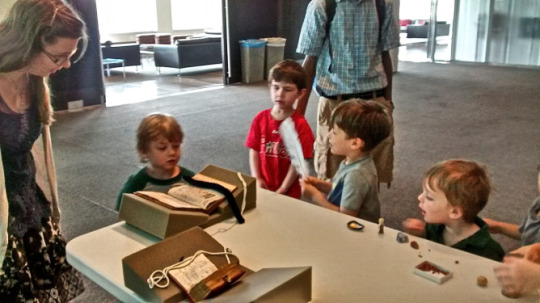
A couple of weeks ago, we hosted a group of four-year olds from a local child care center in the Kislak Center for Special Collections, Rare Books and Manuscripts in the University of Pennsylvania (the home of the Schoenberg Institute for Manuscript Studies). The visit went so well, we’ll be hosting another group in July. My colleague Deborah Bishov, who arranged the visit, wrote up a short blog post on our library’s main blog, but I also wanted to say a bit more here about how the visit went.
We’ve hosted groups of children before, but they were older – 5th through 7th graders. The idea came from former colleagues of mine in the Lilly Library at Indiana University Bloomington* : Lori Dekydtspotter, Head of Lilly Library Technical Services, and Cherry Williams, Manuscripts Curator in the Lilly. For many years Lori and Cherry have hosted groups of students from schools around Bloomington, a program that they have presented about at the ALA, and published about in books and journals. Shortly after I started at Penn, Lori and Cherry gifted me a box of goodies: quill pens, buckthorn berries, walnut hulls, oak galls, gum arabic, and a mussel shell with gold paint. To this I added a piece of cinnebar, lapis lazuli, saffron, and madder root. On visiting day I meant to bring along an egg and a bag of parsley, but of course I forgot.
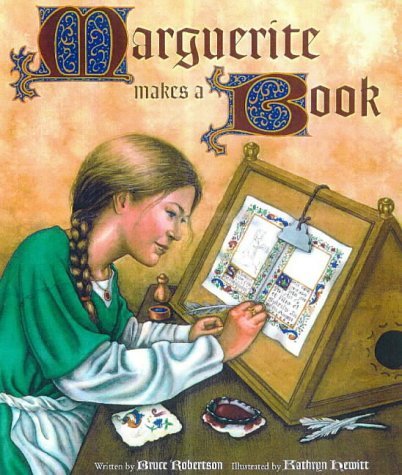
Why these materials? Because they are the materials used by the girl Marguerite in the Getty-published Marguerite Makes a Book, which I loaned to the school about a month before their visit. They read it several times, and they were so excited to remind me of important plot points when needed:
Me: So, Marguerite has to help her father make the book!
One child: The horse stepped on his glasses so he couldn’t see!
Another child: He had to go home to bed!
Yet another child: His name was Papa Jacques!
We had a great time. We started by looking at the cover of the book, which was projected onto a screen.
I pointed to each item at they were able to identify every one! The parchment, the different color inks, the quills (we did have a brief conversation about the weight holding down the parchment). On a long table, I laid out all the materials from my box, plus a piece of parchment from the teaching collection. The children formed a line (more or less) and took turns touching everything – noting the different textures of the two sides of the parchment, the weight of the stones, the smooth shell, the pointy quill. At the end of the table we had set out two of our Books of Hours – very similar to the Book of Hours that Marguerite makes in the book. The kids weren’t able to touch those, but they leaned in nice and close!
Finally we had a question and answer period. We talked about where the books came from, who made them (“No, not Marguerite, she is pretend. But maybe someone like her!”), how they have survived so long, how they got here from England and France, what people did in the Middle Ages, why I am interested in medieval manuscripts, and we talked about how yes, sadly, the people who made these manuscripts are all dead. But their books survive, so a little bit of them survive, too!
This was so great, so much fun. I can’t wait for the next visit!
*I never worked in the Lilly – I worked in the Digital Library Program, which is now defunct, but I worked with the Lilly folks when I could and I still miss them very much!
Reblogging myself because I just spent 30 minutes with another group of preschoolers and I’m feeling very alive right now.
This is fantastic. We have a preschool group scheduled to visit in a couple of weeks, and these are great tips!
So it’s Women’s History Month, and you’d like to read some female authors. “But where do I start?” You cry. Your high school reading list was a long line of white dudes and your college syllabi weren’t all that different, and you can only reread Pride and Prejudice so many times. It’s okay: we’ve got you covered. As a starter pack, here’s a few famous books by male authors, paired with a book by a female author you could read instead.
Kerouac’s famous stream-of-consciousness ode to the beat generation is one of the classic travel narratives of American literature. Solnit also contemplates travel, but from a very different perspective. Her book addresses the issues of wandering, being lost, and the uses of the unknown. Less a work of theory than a conversation with a friend, Solnit draws to the heart of what compels us to wander – “a series of peregrinations, leading the reader to unexpected vistas.” (New Yorker)
Ernest Hemingway’s first novel is about the romance between an expatriate ambulance driver and an English nurse, thinly based on his own experience during World War I. Nightwood, published in 1936, is also a modernist novel focusing on Robin Vote and the American Nora Flood, two women seeking inner peace in their relationship with each other. Djuna Barnes dwells on both the glory and isolation that come with being an outsider, and her novel is also based partly on Barnes’ own life.
Franzen’s most recent novel focuses on the journey of young woman Pip (real name Purity) and her journey to figure out her identity. Rachel Cusk’s novel, told in ten conversations, draws a spare portrait of a novelist teaching creative writing in Athens, seeking to come to terms with a tragedy in her past. Her elegant prose and highly intelligent writing create a compelling portrait of how we hide ourselves from others.
Like Cormac McCarthy’s dark, hyper-violent Western, The Outlander takes place in the early 19th century in southern Alberta. About a woman who flees into the wilderness after murdering her husband, Adamson also dwells on the hardships and brutality of the American West, but from the point of view of a female protagonist trying to escape her vengeful pursuers, retreating ever deeper into the wilderness of both the mountains and herself.
Updike is well known for writing portraits of the lives of the small town middle class. My Name is Lucy Barton is a book about the relationship between an estranged mother and daughter and the complicated love between them. Her style is undramatic and never sentimental, focusing on that which is often unspoken and only implied to create a subtle portrait of two small town women.
Frequently both called authors of “creative nonfiction”, Norman Mailer’s book follows a decorated war-hero as he descends into murderous insanity, while Joan Didion writes about an unfulfilled New York actress telling her story from a psychiatric institute after a mental breakdown. Joan Didion dwells compellingly on themes of alienation and the breakdown of the elite, and the disintegration of American culture and morals.
Anne Sexton’s deeply personal, confessional poetry can be compared with Bukowski’s writing on his relationships with women, alcohol, and writing. Anne Sexton’s poetry was frequently daring, dwelling on taboo topics such as abortion, menstruation, adultery, and drug addiction in a dramatic, sometimes rough voice.
In the 30s, John Steinbeck addressed economic injustice in his story of a family of Dust Bowl migrants struggling to make their way. Carola Dibbel writes a modern day story grappling with modern inequality, set in a near future plagued by disease and disparity, centering around a woman who finds herself at the mercy of dubious experimentation just to survive.
Instead of picking up Robert Heinlein’s science fiction story about a strange man from Mars who teaches Earthlings his customs, try Octavia Butler’s Xenogenesis Trilogy (published in one volume as Lilith’s Brood) about Lilith Iyapo and the Oankali, an alien race seeking to save the Earth by merging with mankind, and the struggles of humankind of maintain their own culture and identity while mercing with another species. Lilith’s Brood exhibits all of Butler’s deep understanding of human strengths and flaws.
An epic fantasy that, like the A Song of Ice and Fire series, features complex and treacherous politics and deeply flawed characters, Robin Hobb’s series tells the story of a prince’s bastard son, trained as an assassin, who finds himself caught up – and overwhelmed by – the intrigues of the powerful people around him – all while the strange menace of the Red Ship Raiders continues to threaten the Six Duchies.