There are a lot of things that go into creating a compelling action scene. One of the most basic principles is something that doesn’t really have an agreed-upon name, but I’m going to borrow a term from one of my writing teachers and call it Good News/Bad News. It’s a shorthand term for the reversals of fortune that make an action sequence exciting, the alternating moments of “FUCK YEAH!!” and “OH SHIT!!” that take us on an emotional rollercoaster during a fight or a chase or a battle.
I could use any of the action sequences in Fury Road to demonstrate how this works, but the fight between Max and Furiosa is a nice clean and simple (for this movie) example.
Let’s say we’re rooting for Furiosa in this fight. It starts with Bad News: strange dude rolls up threatening them with a shotgun.
Furiosa decides to attack, tackles him and gets the gun away from him in one move. Good news!
But the gun doesn’t fire. Bad news!
But she can still use it as a club. Good news!
But Max gets his shit together, grabs her throat and flips them, trying to pin her. Bad news!
But Angharad pulls Max away using the chain. Good news!
But he takes the gun with him. Bad news!
But Dag’s on point with the bolt-cutters. Good news!
And so on and so on; you get the idea by this point.
Most action sequences rely on this dynamic to some extent. The rhythm might be more “good news-bad news-bad news–BAD NEWS!!!” if our protagonists are in a jam, but the reversals of fortune are what keep things interesting.
Tweaking the ratio of good news to bad news creates different effects. Too much good news can make your hero seem invulnerable or like the fight is too easy for them, but a streak of good news after a long run of bad news can create a powerful breath of relief and euphoria at things finally working out for our protagonist. (Think of the War Rig’s engine revving up again at a particularly bleak moment in the final chase.)
Create a really long string of mostly bad news and you have a horror movie. But a scene or sequence that’s nothing but bad news can have diminished returns, or make it feel like your protagonist is passive or doesn’t have any agency.
(I could write a whole other post about how to create a sense of agency for a character who’s in a situation where they can’t physically fight back. For now I’ll just say that someone struggling to turn the situation to their advantage in whatever way they can, even if they end up losing, feels a lot different for the audience than someone just suffering an endless string of blows from their opponent.)
One of the things that makes the action in Fury Road so fantastic is the truly blistering pace of reversals of fortune the movie achieves. In the fight between Max and Furiosa, almost every move is a reversal of who’s on top–metaphorically and often literally. The fight is only two minutes long from start to finish, but it feels like a major set piece because almost every move in the fight is a new beat in the emotional story the action is telling us.
The unrelenting speed with which all the action sequences in Fury Road flip between good news and bad news is part of what makes them feel so exciting, and also so genuinely dangerous, because we’re made to feel like we’re one move away from disaster at all times.
Once again, all good action sequences do this to some extent. Fury Road just does it really, really, really well.
Sylvia Plath: There certainly isn’t enough genuine talent for us to take notice.
Rudyard Kipling: I’m sorry Mr. Kipling, but you just don’t know how to use the English language.
Emily Dickinson: [Your poems] are quite as remarkable for defects as for beauties and are generally devoid of true poetical qualities.
Ernest Hemingway (on The Torrents of Spring): It would be extremely rotten taste, to say nothing of being horribly cruel, should we want to publish it.
Dr. Seuss: Too different from other juveniles on the market to warrant its selling.
The Diary of Anne Frank: The girl doesn’t, it seems to me, have a special perception or feeling which would lift that book above the ‘curiosity’ level.
Richard Bach (on Jonathan Livingston Seagull): will never make it as a paperback. (Over 7.25 million copies sold)
H.G. Wells (on The War of the Worlds): An endless nightmare. I do not believe it would “take”…I think the verdict would be ‘Oh don’t read that horrid book’. And (on The Time Machine): It is not interesting enough for the general reader and not thorough enough for the scientific reader.
Edgar Allan Poe: Readers in this country have a decided and strong preference for works in which a single and connected story occupies the entire volume.
Herman Melville (on Moby Dick): We regret to say that our united opinion is entirely against the book as we do not think it would be at all suitable for the Juvenile Market in [England]. It is very long, rather old-fashioned…
Jack London: [Your book is] forbidding and depressing.
William Faulkner: If the book had a plot and structure, we might suggest shortening and revisions, but it is so diffuse that I don’t think this would be of any use. My chief objection is that you don’t have any story to tell. And two years later: Good God, I can’t publish this!
Stephen King (on Carrie): We are not interested in science fiction which deals with negative utopias. They do not sell.
Joseph Heller (on Catch–22): I haven’t really the foggiest idea about what the man is trying to say… Apparently the author intends it to be funny – possibly even satire – but it is really not funny on any intellectual level … From your long publishing experience you will know that it is less disastrous to turn down a work of genius than to turn down talented mediocrities.
George Orwell (on Animal Farm): It is impossible to sell animal stories in the USA.
Oscar Wilde (on Lady Windermere’s Fan): My dear sir, I have read your manuscript. Oh, my dear sir.
Vladimir Nabokov (on Lolita): … overwhelmingly nauseating, even to an enlightened Freudian … the whole thing is an unsure cross between hideous reality and improbable fantasy. It often becomes a wild neurotic daydream … I recommend that it be buried under a stone for a thousand years.
The Tale of Peter Rabbit was turned down so many times, Beatrix Potter initially self-published it.
Lust for Life by Irving Stone was rejected 16 times, but found a publisher and went on to sell about 25 million copies.
John Grisham’s first novel was rejected 25 times.
Jack Canfield and Mark Victor Hansen (Chicken Soup for the Soul) received 134 rejections.
Robert Pirsig (Zen and the Art of Motorcycle Maintenance) received 121 rejections.
Gertrude Stein spent 22 years submitting before getting a single poem accepted.
Judy Blume, beloved by children everywhere, received rejections for two straight years.
A Wrinkle in Time by Madeline L’Engle received 26 rejections.
Frank Herbert’s Dune was rejected 20 times.
Carrieby Stephen King received 30 rejections.
The Diary of Anne Frank received 16 rejections.
Harry Potter and The Philosopher’s Stone by J.K. Rolling was rejected 12 times.
Interestingly, brain scientists recently studied normal people and authors (we are abnormal, lbr) when writing. Normal people queue a visual image and then try to write it, so the two parts of the brain light up sequentially. Authors queue up both the visual image and the words, so you are finding the language to describe the image even as you imagine it. Which is exactly what I do. I don’t watch a movie in my head first; I describe the movie as I’m watching it.
Yes! I mean, I’m sure there’s a variety of processes, but “describe the movie as I’m watching it” sounds a lot like what it feels like to me.
If I can’t get the movie to play, it’s very hard for me to write something. When I’m creating original characters, I know once I start hearing their voices saying dialogue that I can start writing instead of just making notes.
And sometimes the movie keeps playing after I thought it came to a nice end. (Oh…you guys are having more sex…okay, I’ll just keep writing it down. ;-))
I think is part of why I find screenwriting to be something easy to switch to. It’s already more or less how I think anyway, just write down less description.
DO YOU KNOW THAT KIND OF WRITER’S BLOCK WHERE YOU ALREADY HAVE A PLOT, YOU KNOW WHAT TO WRITE BUT YOU DON’T KNOW HOW TO WRITE IT AND YOU JUST STARE AT THE COMPUTER SCREEN FOR HOURS UNTIL YOU FINALLY CLOSE THE DOCUMENT AND CURSE YOUR ENTIRE EXISTENCE
One last post on the subject, and then, I promise, I am done. 8)
One last question.
Imagine a girl. Who loves Captain America 2, even though she never saw the first one. Or who has been watching Battlestar Galactica reruns non-stop for the last couple of months. Or who found that old Orlando Bloom folder and thought about PotC movies for the first time in years.
Imagine that girl, having an idea. How awesome would it be if Peggy time traveled to the present to help Steve? Or if Starbuck was a Cylon? or if Elizabeth’s best friend from childhood showed up and they ran off to be lesbian pirates?
What if.
What if she could find herself, find a place for herself in a world, in a place that she loved? What if between work and school and family and friends and afterschool activities and a thousand other things, what if that girl wrote her story? HER story. One unique to her, even if it was every trope in the entire world, all rolled into one monstrosity on FF.net.
Maybe she wants to be a writer someday. Or a filmmaker. She wants to create comics. Or tv shows. Or run websites. Or maybe not any of that. Maybe she wants an audience. Maybe she just wants to share this one story with a community she loves.
But she writes it and she posts it and someone says, “Mary Sue.”
And if she knows anything about fandom, if she’s been on the internet, she knows that’s bad. She knows that means she’s failed somehow, that this story, this fun thing that she’s thought so much about, is somehow unacceptable.
She’s told that her female characters are unwelcome. Her story is unwelcome. She is unwelcome.
Maybe she shrugs it off and keeps writing. Maybe she conforms, writes fewer ‘Mary Sues,’ and more canon white het males. Maybe she grows up and becomes a screen writer and carries a life time of ‘girls don’t belong’ judgments into everything she creates, perpetuating the cycle.
And maybe she just stops trying to find herself in that world. Maybe she internalizes it. Maybe she keep dreaming, but never posts another word.
I am adult, with experience, and a job, and something of a readership. And let me tell you, the first time that landed in my comments, it hurt. There was a drop of shame in my stomach, a little roll of nausea. That I had created A MARY SUE.
My first thought? How to devalue the character. How to lessen her. How to strip her of the things that made her funny, made her clever, made her loyal and strange and amazing. Because my readership, I thought, didn’t want amazing.
Amazing was a failure, somehow.
I caught myself doing it. I caught that thought before it got too far. I caught myself thinking, “does she really need to be here?” when I never thought that about any of the male characters. I caught myself.
And then I got angry.
I got angry with myself, that I was so easily browbeaten. That I had almost let one anonymous voice, one mocking, disdainful voice, change how I saw this character. That I almost let someone do that to her.
That I had come so close to writing her out. Because she was a Mary Sue.
I don’t care if you use the term as gender neutral. It’s not. It carries connotations in fandom. It carries shame. It carries the unspoken weight of ‘fake geek girl’ and ‘codebabes’ and ‘I like my fangirls like I like my coffee, and I HATE coffee!’ It is another attempt to shame and silence, and I am done with it.
And if my niece grows up in ten years, and gives me her fic, about how Angelica Perfecton gets engaged to Spider-Man and saves Tony Stark by fixing his armor and teaches Steve Rogers how to paint?
Then I will be so overjoyed that she is a fan. That she is a fan who CREATES. Who makes the space safe for herself. Who dreams big. Who wants to be the center of the world she loves so much.
Because it is her right to do that without shame.
“I don’t care if you use the term as gender neutral. It’s not. It carries connotations in fandom. It carries shame. It carries the unspoken weight of ‘fake geek girl’ and ‘codebabes’ and ‘I like my fangirls like I like my coffee, and I HATE coffee!’ It is another attempt to shame and silence, and I am done with it.”
I’ve been thinking it over, and I’ve come to the conclusion that writing a fic is a lot like taking a road trip.
It’s always better when shared with at least one other person who’s as interested in the journey as you are, someone to help you navigate but also sometimes to back you up on an impromptu detour because PIE STAND! TOY MUSEUM! BADASS WATERFALL! LET’S JUST TAKE A QUICK LOOK THERE COULD BE COOL STUFF OVER THERE!
At the beginning you’re super excited and full of eager anticipation, ready to hit the road and get your adventure underway.
There’s always at least one unexpected awesome thing that you discover along the way.
There’s also, depending on the length of your trip, at least one point where you’re convinced that you are going to be driving forever. You had no life before this car, there has only ever been the road, this is where you will die, how are you not there yet?
This was a terrible idea, you should’ve just stayed home.
This was an AWESOME idea, you are in control of your own destiny and you should do this sort of thing all the time.
Sitting staring at the same rectangle of glass for untold hours at a time.
Consuming probably rather more junk food and caffeine than you really ought to.
The desperate hunt to find music that will properly set the mood.
Yet another detour that’s really legitimately important.
Fifteen times as many detours that are total wastes of time, why on earth do you keep thinking they’re necessary?
Long stretches where the road just seems so tedious, and you know you have to get through it but you think you’re gonna lose your damn mind before you do.
Unexpected construction zones where everything grinds to a near halt.
That point near the end where you think you’re almost there, but actually you have like another hour and a half to go.
Posted on
Remember: Comparison is the thief of joy. No matter how high you climb, it’s always easy to worry about who has climbed higher, or if you are climbing fast enough.
I keep this quote on my writing desk and stare at it every day to remind myself never to compete against anyone except myself. There will always be someone better, and there will always be someone else who believes that I am better than they are. It doesn’t matter a whit—what matters is your heart and your drive. And nothing else.
Lisa Amowitz is the author of fantasy/thrillers for young adults, including Until Beth. She is also a cover designer and a professor of Graphic Design at Bronx Community College.
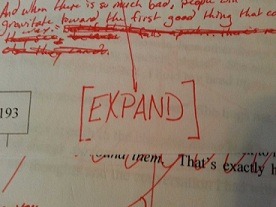
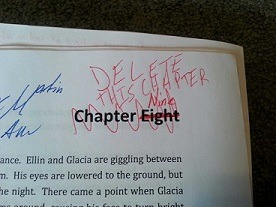
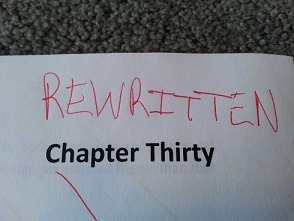
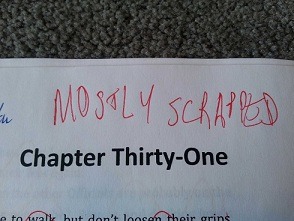
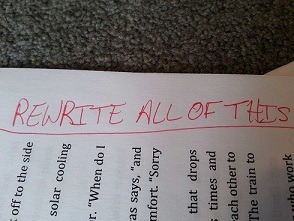
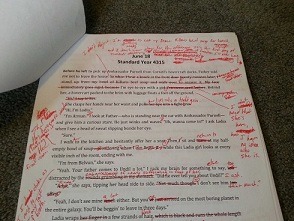
Yes. Writing a book is the easiest thing in the whole world. In fact, let me show you just how easy it is!
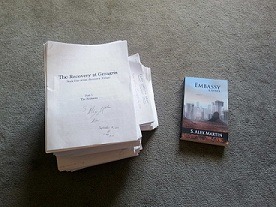
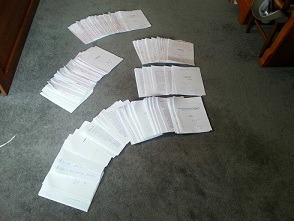
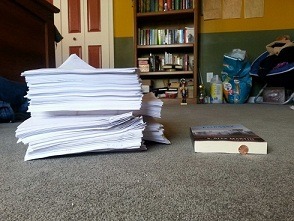
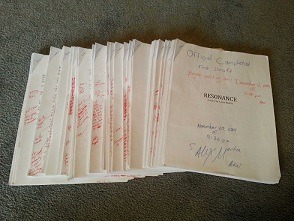
Goal: change all this paper into a book.
Eh, not that hard. I mean, you just have to read, right?
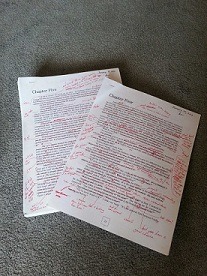
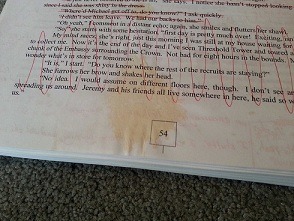
Maybe scratch a few notes in the margins as reminders.
Yeah, writing and editing isn’t time consuming or painstaking at all.
In fact, I find it quite relaxing. Good meditation. No stress whatsoever!
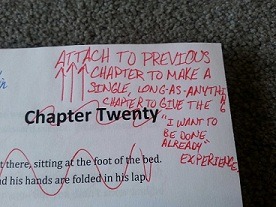
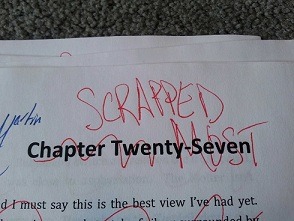
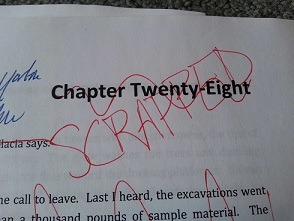
I mean, it’s not like writing a book involves any train of thought or decision making, like when to cut scenes, because whatever you write is perfect and there to stay!
I mean, come on, it’s not like I’m going to rewrite the first chapter 51 TIMES to make sure it’s how I want it, right? That’d be crazy.
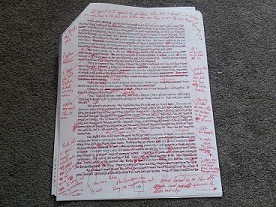
And no, it’s not like I spent over 3,000 HOURS READING AND REVISING 14 DRAFTS OF THE BOOK to make this book readable.
No sweat, no tears, no blood, and DEFINITELY no coffee stains.
Nope, writing is the easiest job in the world. I don’t see why anyone thinks otherwise. I mean, all we do is scribble words and take a few out, right?
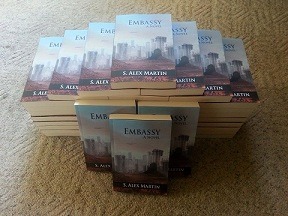
We feel no satisfaction AT ALL when we receive a shipment of the final product for a book signing. *yawn* BOR–ING.
Nope, we don’t get excited at all. It’s just another day in the life.
And the sequels? Bitch, please. That’s child’s play.
You’re right. Writing a book is so easy. It’s not stressful, not exciting, and it’s definitely not worth the reward of holding something that USED TO BE EXCLUSIVELY IN YOUR HEAD AND NOW YOU GET TO SHARE IT WITH THE WHOLE WORLD.
Writing a novel when you imagine all you stories in film format is hard because there’s really no written equivalent of “lens flare” or “slow motion montage backed by Gregorian choir”
You can get the same effect of a lens flare with close-detail descriptions, combined with breaks to new paragraphs.
Your slow-motion montage backed by a Gregorian choir can be done with a few technques that all involve repetition.
First is epizeuxis, the repeating of a word for emphasis.
Example:
Falling. Falling. Falling. There was nothing to keep Marie from plunging into the rolling river below. She could only hope for a miracle now, that she would come out alive somehow despite a twenty-foot drop into five-foot-deep water.
Then there’s anaphora, where you write a number of phrases with the same words at the beginning.
There were still mages out there living in terror of shining steel armor emblazoned with the Sword of Mercy.
There were still mages out there being forced by desperation into the clutches of demons.
There were mages out there being threatened with Tranquility as
punishment for their disobedience, and the threats were being made good
upon.
Mages who had attempted to flee, but knew nothing of the outside
world and were forced to return to their prison out of need for
sustenance and shelter.
Mages who only desired to find the families they were torn from.
Mages who only wanted to see the sun.
This kind of repetition effectively slows the pace of your writing and puts the focus on that small scene. That’s where you get your slow pan. The same repetition also has a subtle musicality to it depending on the words you use. That’s where you get the same vibe as you might get from a Gregorian choir.
Damn I made relatable reblog- bait post and writer Tumblr went hard with it. This is legitimately very good advice.
I thought about it, but I didn’t think anyone would want to watch me write
I know!!!! I feel the same way!!! “Hey would you like to watch how terribly I misspell things? Or watch as I bumble through misshapen sentences until I go back and reread it until I correct my horrible endless run ons?! then come on down to my stream!!” But I’ve heard from reliable sources that there are those that do it! I was wondering if my lovely followers have witnessed any.
I feel the same way really. I feel like no one would want to watch me stumble through writing it and make all of those mistakes and horrible beginnings
Oh wow what a nightmare. First drafts are not for anyone’s eyes but mine. Not even for educational purposes.
I’ve thought about streaming myself writing. But I also don’t know that anyone would be interested in it. I don’t mind sharing first drafts, I don’t generally edit that much anyway