When you are writing a story and refer to a character by a physical trait, occupation, age, or any other attribute, rather than that character’s name, you are bringing the reader’s attention to that particular attribute. That can be used quite effectively to help your reader to focus on key details with just a few words. However, if the fact that the character is “the blond,” “the magician,” “the older woman,” etc. is not relevant to that moment in the story, this will only distract the reader from the purpose of the scene.
If your only reason for referring to a character this way is to avoid using his or her name or a pronoun too much, don’t do it. You’re fixing a problem that actually isn’t one. Just go ahead and use the name or pronoun again. It’ll be good.
Someone finally spelled out the REASON for using epithets, and the reasons NOT to.
In addition to that:
If the character you are referring to in such a way is THE VIEWPOINT CHARACTER, likewise, don’t do it. I.e. if you’re writing in third person but the narration is through their eyes, or what is also called “third person deep POV”. If the narration is filtered through the character’s perception, then a very external, impersonal description will be jarring. It’s the same, and just as bad, as writing “My bright blue eyes returned his gaze” in first person.
Furthermore,
if the story is actually told through the eyes of one particular viewpoint character even though it’s in the third person, and in their voice, as is very often the case, then you shouldn’t refer to the characters in ways that character wouldn’t.
In other words, if the third-person narrator is Harry Potter, when Dumbledore appears, it says “Dumbledore appears”, not “Albus appears”. Bucky Barnes would think of Steve Rogers as “Steve”, where another character might think of him as “Cap”. Chekov might think of Kirk as “the captain”, but Bones thinks of him as “Jim”.
Now, there are real situations where you, I, or anybody might think of another person as “the other man”, “the taller man”, or “the doctor”: usually when you don’t know their names, like when there are two tap-dancers and a ballerina in a routine and one of the men lifts the ballerina and then she reaches out and grabs the other man’s hand; or when there was a group of people talking at the hospital and they all worked there, but the doctor was the one who told them what to do. These are all perfectly natural and normal. Similarly, sometimes I think of my GP as “the doctor” even though I know her name, or one of my coworkers as “the taller man” even though I know his. But I definitely never think of my long-term life partner as “the green-eyed woman” or one of my best friends as “the taller person” or anything like that. It’s not a sensible adjective for your brain to choose in that situation – it’s too impersonal for someone you’re so intimately acquainted with. Also, even if someone was having a one night stand or a drunken hookup with a stranger, they probably wouldn’t think of that person as “the other man”: you only think of ‘other’ when you’re distinguishing two things and you don’t have to go to any special effort to distinguish your partner from yourself to yourself.
This is something that I pretty consistently have to advise for those I beta edit for. (It doesn’t help that I relied on epithets a lot in the earlier sections of my main fic because I was getting into the swing of things.) I am reblogging this so fanfic writers can use this as a reference.
A good rule of thumb: a character’s familiarity with another character decreases the need for an epithet (and most times you really don’t need one at all).
Good writing advice.
I think there does come a point when a character’s familiarity actually wraps around and does make epithets relevant again, and it’s when referring to a relationship. (I remember in a short story that I’ve otherwise entirely forgotten, a ~modern~ woman saying that she had her nephew call her by her first name, and the POV character thinking how sad it was to put the distance of a name between family members–and there’s something to that.)
Most of the time when I’m writing a character interacting with their parent or grandparent, the parent isn’t referred to by name in narration–because most characters don’t think of parents and grandparents by their first name–but as “his mother” or “his father” or “her mom” or “her dad”–and this can be used to very compactly convey information about the nature of the relationship, because there’s a big difference between “my Grandmother Hardison” and “my Nana” or between “the Count my father” and “my Da.”
And if the character is a different kind of family member–a sibling, a child, a spouse–then the moments when a character thinks not of “Erik” but “his cousin,” not of Thor but “his brother,” can be used for great effect. The author just needs to be aware of when they’re particularly highlighting the relationship and when that’s not what they need to draw attention to.
Well, somebody has to accomplish your dream of becoming a writer.
And it might as well be you.
Now, read everything you can. Write a lot. (You’re 16. You don’t have to finish everything you start. Just write.) Get all the living in you need. Meet all the people you can. (Life is useful for plots. People are useful for characters.) And have fun with it.
I think that there’s some kind of mindset in a lot of creative communities (authors, artists, musicians) that your work needs to be groundbreaking and thought-provoking for it to matter. That in order for it to be considered worthy of its medium, it must have a greater purpose.
And if you ask me, its bullshit.
God, it puts so much stress on a creator to have to be important to someone else. I have seen so many people give up because their work isn’t making a statement, that it’s ‘fluff but no substance.’ As though there’s only room for so many people in a community of creators that only people with a point can get in.
If it made someone laugh, it’s important.
If it made someone smile, it’s important.
If someone looks back on it fondly, even for a moment, it’s important.
If you enjoyed making it, even if you never shared it, it’s important.
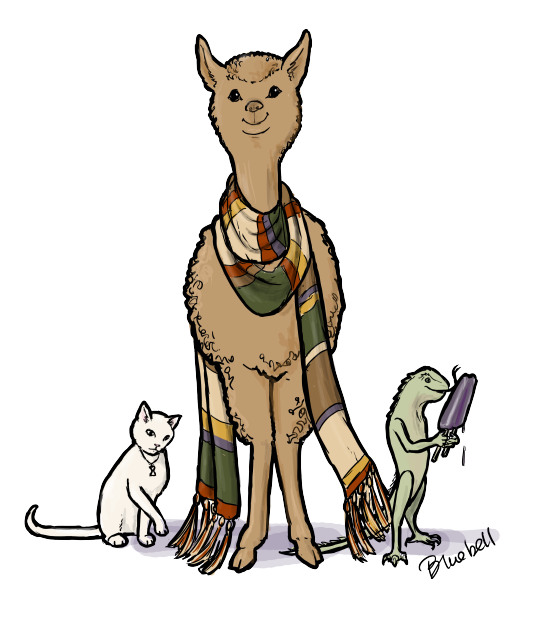
Sing songs about your cat, draw pictures of lizards eating popsicles, and write a series of novels about time-traveling alpaca.
The world is already full of super-important stuff. Write fluff.
I have a friend (published) who looks down on fanfiction because she doesn’t think it’s “real” writing since it can’t sell. Let me tell you, I truly pity her for never knowing the JOY that is fluff (fan)fiction.
ALL writing and art MATTERS. Nuff said.
This is so true. If matters to you, it is important.
It is also making want a story about an alpaca who travels through them with a cat and a lizard, all eating popsicles.
“if it’s not plot relevant, cut it!!” is such awful writing advice
if JRR Tolkien had cut every bit of Lord of the Rings that wasn’t directly related to the central plot, it would have been just one book long, COLOURLESS and DULL AS DIRT.
all the little worldbuilding/character details are what draw you in and give the central plot weight, FOOL
I agree 100% I’m currently writing a book and I tend to focus on the little quirks of the characters because it helps the readers get to know them better
It’s not awful writing advice. It’s good writing advice. What it’s saying is that you should carefully consider each and every word.
Does this paragraph pull its weight?
Does this chapter slow the pace of the story? Is that what I want here?
Can I merge this scene with another to create a stronger single scene?
What that advice is telling you to do is to make sure what you’re writing is the best it can be. That doesn’t mean you have to follow it 100%. But consider it while you’re writing.
I honestly feel like both Tolkien and George RR Martin would’ve been served by cutting some scenes. HOWEVER, I like tightly paced books, not sprawling slogs through the swamps of discovery writing.
Your mileage may vary.
I mean i fundamentally disagree with you on that last part (i love a long, thick, meaty book) but you’re also misunderstanding what i mean (which is understandable, this was just a ranty little post that i didn’t expect much of anyone to reblog)
there’s a difference between “plot" and “story”
there are a lot of great stories that have very little in the way of central plot (ever read the hitchhiker’s guide to the galaxy? there’s hardly any plot to that at all, it’s just a long series of diversions and narrative blind alleys) and even in more focused stories (someone else in the notes of this post brought up Hamlet as an example), it’s extraneous scenes, not directly related to the plot, that make the strongest impression on the audience and lend weight to the more central events. The “alas, poor yorick” scene? totally unrelated to the main plot, yet thematically essential to the story and arguably the most evocative and iconic scene from the play
yes, by all means don’t waste your audience’s time with things that add nothing, but if you pull a hemingway and trim your story down to the bare minimum outline of the plot, i for one will find it all but impossible to become immersed in the story. The best plot ever written can be let down by a lack of narrative muscle and fat around it but even the most flimsy plot can be saved by sufficiently entertaining padding.
me writing dialogue: “what is man but a vessel through which a higher entity may see? what is his purpose? must he find a purpose? we are but stardust; the universe comprehending itself.”
me writing action: they ran real fast from the bad men aand legs hurty
me writing action: Her legs pounded against the earth, the familiar jolt grounding her like nothing else could. Magic, gods, royalty—she didn’t know anything about that. But running? That’s something she’d been doing since day one.
me writing dialogue: “I dunno man whatchu wanna do” “I dunno. What do you think?” “Hey man I don’t know”
me writing action: room go boom
me writing dialogue: noppity nope, that ain’t dope
The fic i just posted is my 175th fic. What the hell am I doing with myself?
I was going through my me tag and found this. Oh past me, you’re adorable. That was slightly less than 2 years ago, 4/22/2014. Sweetie, you’ve got 325 fics now. and that’s not counting the co-writes. You’re still just as crazy fast a writer as you were, just you’ve continued to improve.
Hey past me it’s Sept 1 2018, another 2 years later and not only do you now have 458 fics by yourself, you’re over a milion and a half hits across everything. You just celebrated 5 years of writing Sherlock and you’re still going strong.
Oh my God I’m not sure of the accuracy of this scale but I made one anyways.
1: Jane Austen. Theoretically Romantic, mostly a clever satirist more interested in the novel as the perfect vehicle for social commentary than in poetry for capturing emotion. Very little chance of swooning and/or dramatic death. A very safe spot on the Romanticism scale.
2: Dorothy Wordsworth: Actually a Romantic, though not excessively so! Enjoy your long walks in the country. Keep those diaries. Your brother can mine them for publishable material until people consider them finally worthy of academic interest a century or two later.
3: Wordsworth. May result in later becoming annoyingly conservative but mostly harmless. Go ahead and wander lonely as a cloud. Gaze upon that ruined abbey.
4: Charlotte Turner Smith. Recover that English sonnet and transform it into a medium that mostly expresses sorrow! Help establish Gothic conventions! Have what Wordsworth called a true feeling for rural England! Die in penury and be forgotten by the middle of the nineteenth century!
5: Blake. ?? Who even knows man. Talk to angels. Create your own goddamn religion. Confuse all of your contemporaries.
6: Mary Shelly. Go ahead and run off with that unhappily married poet who took you on dates to your mother’s grave, but this may result in carrying your husband’s calcified heart around in a fragment of his last manuscript the rest of your life. But also, arguably inventing sci-fi as a genre… so that’s some consolation.
7: John Keats: listen to that nightingale but be forewarned: you will die of TB in Rome and everyone will mock you for dying of bad criticism instead of, you know, infectious disease.
8: Coleridge. May result in never finishing a poem and a severe opium addiction.
9: Percy Shelly. May result in being expelled from Oxford and in premonitions of your own death by drowning.