when reading anything i write please interpret each exclamation point as one wag of a golden retriever’s tail
e.g. if i type “aaaaaaaaah thank you!!!!!!!!!!!!!” please imagine i am furiously wagging my tail and possibly causing minor property damage to low positioned vases, lamps, tchotchkes, etc.
“About two-thirds of the way through production, we changed the story to Judy’s story… we said, let’s just try, as an experiment, making Judy the main character — since she’s anoptimist, she sees the best in everything — let’s try making it her story and see what happens.” – Zootopia director, Rich Moore (x)
If you ever worry that it’s too late to change a story remember that zootopia changed their lead on a fully animated film a year before release…and pulled it off. Yes they had to scrap work that had been done, but the film was better in the end.
Your story is 50% reader. It’s that mixture of reader and writer that makes the magic.
Which means your story needs to have holes for the reader to fill in. You need that negative space for the puzzle pieces to fit.
I’m not talking about plot holes, I’m talking about giving one sentence the power of two. A book that means what it says is a mediocre book. A book that means more than what it says is a great book.
Don’t over-develop your characters, having them analyze every feeling, or spelling out what every character in a scene is thinking. Don’t follow up a powerful line with an explanation with what makes that line powerful.
Let your words imply as much as they state.
it can be so so hard sometimes, cuz i gotta remember i can trust my readers
And it can be hard to know WHICH holes to leave. You don’t want to leave any ‘this doesn’t make sense’ holes, but you do want to leave ‘insert your interpretation here’ holes.
this is the most important think I have ever learned about writing
Posted on
No writing is wasted. Did you know that sourdough from San Francisco is leavened partly by a bacteria called lactobacillus sanfrancisensis? It is native to the soil there, and does not do well elsewhere. But any kitchen can become an ecosystem. If you bake a lot, your kitchen will become a happy home to wild yeasts, and all your bread will taste better. Even a failed loaf is not wasted. Likewise, cheese makers wash the dairy floor with whey. Tomato gardeners compost with rotten tomatoes. No writing is wasted: the words you can’t put in your book can wash the floor, live in the soil, lurk around in the air. They will make the next words better.
Writing a novel when you imagine all you stories in film format is hard because there’s really no written equivalent of “lens flare” or “slow motion montage backed by Gregorian choir”
You can get the same effect of a lens flare with close-detail descriptions, combined with breaks to new paragraphs.
Your slow-motion montage backed by a Gregorian choir can be done with a few technques that all involve repetition.
First is epizeuxis, the repeating of a word for emphasis.
Example:
Falling. Falling. Falling. There was nothing to keep Marie from plunging into the rolling river below. She could only hope for a miracle now, that she would come out alive somehow despite a twenty-foot drop into five-foot-deep water.
Then there’s anaphora, where you write a number of phrases with the same words at the beginning.
There were still mages out there living in terror of shining steel armor emblazoned with the Sword of Mercy.
There were still mages out there being forced by desperation into the clutches of demons.
There were mages out there being threatened with Tranquility as
punishment for their disobedience, and the threats were being made good
upon.
Mages who had attempted to flee, but knew nothing of the outside
world and were forced to return to their prison out of need for
sustenance and shelter.
Mages who only desired to find the families they were torn from.
Mages who only wanted to see the sun.
This kind of repetition effectively slows the pace of your writing and puts the focus on that small scene. That’s where you get your slow pan. The same repetition also has a subtle musicality to it depending on the words you use. That’s where you get the same vibe as you might get from a Gregorian choir.
Damn I made relatable reblog- bait post and writer Tumblr went hard with it. This is legitimately very good advice.
The entire world forever: Ugh stop with your self-insert Mary Sue fics/cozy domestic chick lit/depiction of romantic relationships/female friendships/no one wants this/this isn’t *real* literature
Meanwhile portrayals of dudes in genre literature are basically like:
Like clockwork, I have received my first reblog implying that if the world is yelling at the women writers then it’s their own fault for not being imaginative enough 😀 😀 😀 😀
Don’t have them die of old age after a long, fulfilling life. Many people don’t even think of this as sad (note that this can still work if you have enough of the other factors).
Leave one of their major goals unfinished. The more enthusiastic they are about completing the goal, the sadder.
Give them strong relationships with other characters.
Make them fight against whatever is causing their death. Their ultimate loss is sadder if they struggle.
Kill them in the middle of their character arc.
Don’t describe their funeral in detail. Maybe it’s just me, but I find that long descriptions of funerals kill the sadness.
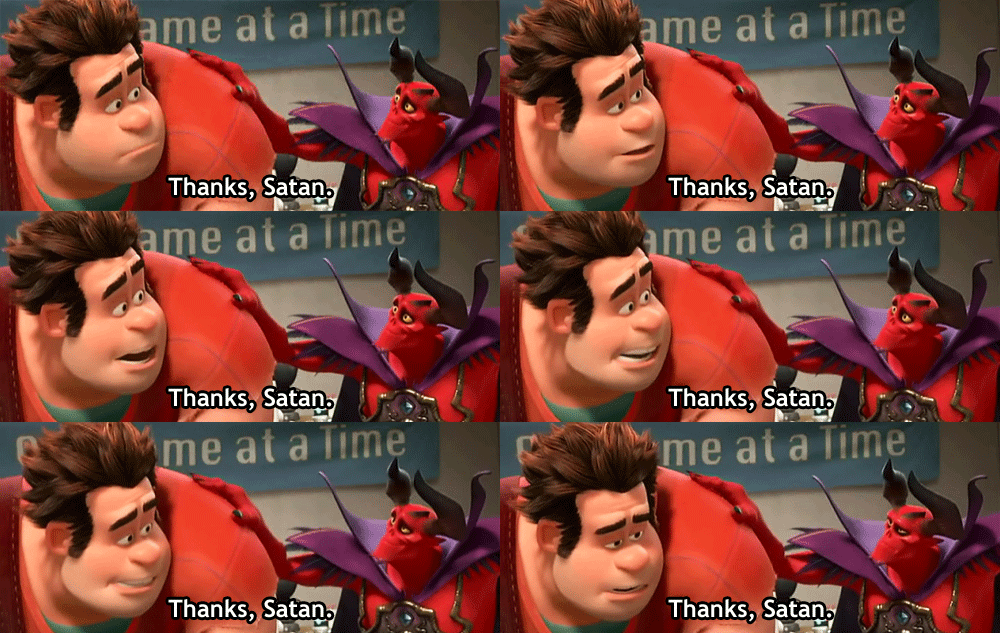
That’s enough Satan’s publisher…
>B)
7. If possible, try to kill them off in the middle of the story, so we had time to like them and we will have time to let the loss settle in.
8. Also, place surviving characters in a situation where having the deceased person there would help them get out. You can choose whether you will point this fact out or if you want the audience to make the connection themselves.
9. Make them die by sacrificing themselves to save someone they love from a danger created by the antagonist.
based on a few deaths that made me blub like a baby…
10. have their loved one, broken hearted, tell the team to stop fighting because “its over.”
11. have their pet come looking for them.
12. have their loved one perform a popular song at their funeral so it makes the fans cry whenever it’s played.
13. family witnessing the death and/or blaming themselves.
~ Mulan
so… let’s add some frustration to your dear readers’ sadness, shall we?
14. kill the character in the middle of making a joke, smiling, or expressing/experiencing joy/happiness.
15. make the character’s death slow and painful, but make them unable to call out for help even though they can literally see the other characters nearby.
16. after killing the character, have others think the character had betrayed them so they’d always hate them and remember them as traitors and never say nice things about them… Give your readers no chance to have group-therapy with other characters by making them the only ones who know the truth.
17. right before their death, show a side of them nobody has seen. (someone who is always tough and brave being genuinely scared of dying alone; someone who is always laughing being in tears before dying, etc.)
18. make them the only person who knows a big important secret that would help other characters in the story.
19. have them being lied to before dying. (thinking they’ve been betrayed; thinking they weren’t loved; thinking they’ve lost their loved ones, etc)
20. make the character very enthusiastic/passionate about a certain goal, constantly put stress on their goal, have them die unexpectedly before they can reach their goal.
and the best one…
21. have another beloved character kill them–better be a close friend to your character, one that absolutely nobody suspects, one that everyone can’t help but love, one who is always enthusiastic about things and encourages your character. THEN
reveal the truth only later when it’s too late and the a-hole character has already escaped.
have a cowardly character know the truth and never tell anyone else
have another character find out the truth and have them die before revealing it to others.
have the said character ^ not actually die, but go through something so they’d forget the friend of the deceased character is actually an asshole.
This way only your readers will know the truth, thus the frustration would be… most enjoyable for you.
Satan out.
22. Don’t kill their body. Kill their mind.
Leave the physical shell walking and talking, but strip out everything that made that person who they were. Make them forget all about their loved ones, themselves, their experiences and past, their skills, and have them have to start over completely from scratch. Physical and mental disabilities bonus points.
And keep them in a place where their loved ones will be taunted every day by a living ghost.
based off of the one character death that physically pains me to think about
23. Make the character a very loving and caring family person, whether it’s with their siblings or parents, their partner, or their children. Make them talk about how much their family means to them frequently. Kill them off before they could even say goodbye.
Bonus points if they have a very young child who means the world to them.
More bonus points if their family member kills them, or they believe their family member to have killed them.
THIS MAKES ME SO INSPIRED TO FINALLY KILL THE SINNAMON ROLL IN CRITICAL SURVIVAL
24. After their death show characters who helped them and who the readers believed were their allies or friends celebrate their death and make jokes of it.
25. And another for not killing their body: Have them come close to death and lose their memory, and after have them work/with for those they were fighting against and find a family there. Their past allies/friends are completely aware of this, except for the person who cared for them most who is drowning in despair believing that they’re dead.
This post got longer since the last time i saw it
26. Make the character you kill a lesbian/bisexual woman. With very little effort from your end, this will upset not only your fans, but the whole LGBTQ+ community and their allies. Good job, you.
Have you ever heard a four-year-old run out of breath before she can finish her thought? I edit a lot of sentences that work the same way. You need a noun, you need a verb, you might need an object. Give some serious thought to stopping right there.
Sentences are building blocks, not bungee cords; they’re not meant to be stretched to the limit. I’m not saying you necessarily want a Hemingway-esque series of clipped short sentences, but most writers benefit from dividing their longest sentences into shorter, more muscular ones.
2. Paragraphs can only do one thing at a time.
A paragraph supports a single idea. Construct complex arguments by combining simple ideas that follow logically. Every time you address a new idea, add a line break. Short paragraphs are the most readable; few should be more than three or four sentences long. This is more important if you’re writing for the Web.
3. Look closely at -ing
Nouns ending in -ing are fine. (Strong writing, IT consulting, great fishing.) But constructions like “I am running,” “a forum for building consensus,” or “The new team will be managing” are inherently weak. Rewrite them to “I run,” “a forum to build consensus,” and “the team will manage.” You’re on the right track when the rewrite has fewer words (see below).
(If for some insane reason you want to get all geeky about this, you can read the Wikipedia article on gerunds and present participles. But you don’t have to know the underlying grammatical rules to make this work. Rewrite -ing when you can, and your writing will grow muscles you didn’t know it had.)
4. Omit unnecessary words.
I know we all heard this in high school, but we weren’t listening. (Mostly because it’s hard.) It’s doubly hard when you’re editing your own writing—we put all that work into getting words onto the page, and by god we need a damned good reason to get rid of them.
Here’s your damned good reason: extra words drain life from your work. The fewer words used to express an idea, the more punch it has. Therefore:
Summer months Regional level The entire country On a daily basis (usually best rewritten to “every day”) She knew that it was good. Very (I just caught one above: four-year-old little girl)
You can nearly always improve sentences by rewriting them in fewer words.
5. Reframe 90% of the passive voice.
French speakers consider an elegantly managed passive voice to be the height of refinement. But here in the good old U.S. (or Australia, Great Britain, etc.), we value action. We do things is inherently more interesting than Things are done by us. Passive voicemuddies your writing; when the actor is hidden, the action makes less sense.
Bonus: Use spell-check
There’s no excuse for teh in anything more formal than a Twitter tweet.
Also, “a lot” and “all right” are always spelled as two words. You can trust me, I’m an editor.
Easy reading is damned hard writing. ~ Nathaniel Hawthorne
Some generally good advice here. Just remember that none of this is set in stone and there is wiggle room for variation in style, tone, and voice.