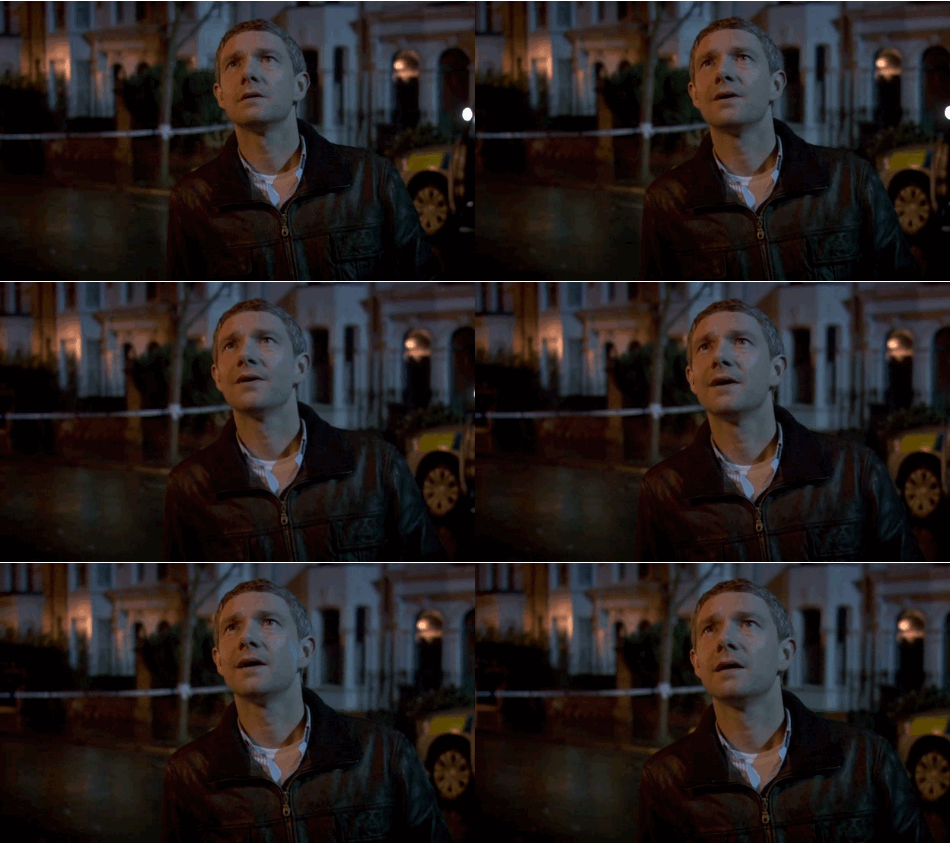
Just to add a little fuel to the fire of that last post…
In The Empty Hearse, Sherlock was pulled out of Eastern Europe* to deal with an emergency back home.
In His Last Vow, one of the papers Janine brought to Sherlock in the hospital included a feature block reading “Eastern Europe Erupts.”
By that evening, Mycroft was so focused on tracking something in Eastern Europe that he could barely be bothered to look up from his computer when Lestrade came to ask about his missing brother.
After Sherlock’s recovery, Mycroft mentioned MI6 wanted to place Sherlock back into Eastern Europe.
But for the second time, an emergency in England put an abrupt end to one of Sherlock’s Eastern European undercover excursions.
So it seems to me that it’s worth at least considering the possibility that “Miss me?” wasn’t about keeping Sherlock home so much as keeping him away from whatever’s going down in Eastern Europe. A good mental exercise and chance to shake up our assumptions, if nothing else.
———
* [Eastern Europe is defined in a number of ways, and the countries said to be part of it vary. Here’s an example of a definition that labels both Serbia and Poland as part of Eastern Europe. I personally feel Mycroft’s Ugly Duckling mission map plus his saying MI6 wanted Sherlock “back” in Eastern Europe when the last foreign country Sherlock had been in was Serbia is enough to consider both countries part of Eastern Europe as the show sees it, but YMMV.]


here’s a thing: I had literally no idea of johnlock/the concept of shipping/fandom communities/anything related to slash pairings before I watched sherlock, and after the first episode I went searching to see if they were/were going to be romantically involved in this version, or if that was even a thing. again: I went looking after ONE SINGLE EPISODE. I know I’m not the only one with that experience.
The meta is intelligent and well thought out, tjlc is amazing (and hilarious and brilliant and I adore it so, so much), but before the meta, before tjlc, there’s simply the show. And the show, on its merits alone, is what led me to the idea of sherlock/john. To me, the show stands by itself, and acting like tjlc is a delusion built by fangirls nitpicking at details is completely untrue.
The text of the show gives you a john who, 2 years later, still can’t visit baker street, it shows you drunk idiots straight up flirting on the stag night, it shows you a heartbroken sherlock after John’s wedding, it shows you that one month into a supposedly happy marriage john is cycling to work due to a bit of chafing, and it shows you sherlock building up to and deciding against a final declaration of love (seriously, what else was he going to say?) Those events textually happen IN THE SHOW, and while meta does wonders to expound on said events, to argue that tjlc and the idea of johnlock endgame are based solely on subtext, solely on tiny details, is simply false.
To me, the meta is the icing on top of the multi-layered and very dense cake of the narrative – and sure, you can have one or the other, but if your cake is awful, all the icing in the world isn’t going to be able to hide that. Essentially: meta and tjlc largely aren’t based on subtextual or tenuous connections, they’re based on the narrative structure itself, which I firmly believe supports johnlock endgame. Someone get me some damn cake.







The next time I see the “it wasn’t canon argument,” I’m going to run screaming at you with copies of the Criminal Law Amendment Act of 1885 and news articles detailing the treatment of convicted homosexuals in 19th Century England, and then continue screaming until you understand exactly what would have happened to Arthur Conan Doyle had he explicitly written Sherlock Holmes and John Watson as gay lovers.
So, I wrote this a bit cheekily last night, but now I want to expand on it with some actual facts. I see a lot of people saying, “Oh, back in the 19th century, Sherlock and John couldn’t openly be together.” And that’s true, but what’s at the heart of that sentiment is this one, “Arthur Conan Doyle couldn’t have written them openly together, because the general public would assume he was encouraging homosexuality, perhaps was even homosexual himself, and that would have been dangerous.” Here’s why.
In 1885, the British Parliament enacted section 11 of the he Criminal Law Amendment Act 1885, known as the Labouchere Amendment which prohibited gross indecency between males. It thus became possible to prosecute homosexuals for engaging in sexual acts where buggery or attempted buggery could not be proven. Note that they didn’t have to actually catch you in the act, they just had to suspect that you did it. During this time period, many notable men were prosecuted with disastrous results; Lord Arthur Chilton committed suicide after being implicated in Boulton and Park trial involving two transvestites and Oscar Wilde was sentences to prison and hard labour after being found guilty.
Was there still a homosexuality culture in England at the time? Yes, it was around this time that the culture began to flourish, with clandestine gatherings preceding the opening of the first gay pub, The Cave of the Golden Calf in 1912. There was even the beginnings of gay erotica and publishing, but it was still very much subversive and not opening distributed among the public.
The opposite of who Arthur Conan Doyle was; Sherlock Holmes increased subscriptions to The Strand magazine by 30,000. While Oscar Wilde, if not embraced, accepted, the consequences of his actions, Arthur Conan Doyle was not in a position to do that. He received a knighthood in 1902, he was involved in political campaigns and other civic work throughout his lifetime, and he had 5 children to support. He was not in a position to risk what an accusation of buggery would bring.
So, when you look at the situation, Arthur Conan Doyle was unable to go any farther than he had with Holmes and Watson in his original stories. Even if he wanted to. Even if he tried to fill it with as much subtext as possible, he would always have to be mindful of what would happen if he went to far.
This is why this argument bothers me so much. Were Sherlock Holmes in John Watson explicitly in a romantic relationship in the original stories? No, and no one is arguing that they were. Are we intended to imply, with the clues that were safe to include given the environment at the time, that it’s a possibility? That’s up to you to decide. But demanding that the only way a relationship could be legitimate is if it had been clearly stated by Arthur Conan Doyle is frustrating because it’s imposing today’s standards on a time period where they do not fit.




After reading so many of your Metas i truly believe Sherlock is in love with John. But i still can’t 100% believe John also loves him. Sometimes I feel john defends himself by saying, “i’m not gay”, “we’re not a couple.”, and so forth and of course there are all those gifs that has John staring at sherlock’s neck. I mean i think john is attracted to sherlock, but not “in love”. I mean sherlock died and gave up his life for him. Where’s the big moment John realizes he’s in love with sherlock?
deducingbbcsherlock-deactivated:
Ok ok, I guess we can’t count the unaired pilot as canon.
I bet others have different readings of this (and I’d love to hear them). For me, these are the big moments.