(Pt. 1, Watching the Detective)
So if your detective’s too pretty and all the girls & boys & others are looking at him a bit too much and a bit too wrong, then you gotta straighten things out. You better bring in a woman, sexualize the fuck out of her, and make clear that she’s the object of a desiring gaze that is obviously male—a gaze that is, at least in part, Sherlock’s. This gives the show a heterosexual object and tries to make Sherlock a heterosexual subject (that is, she’s the object that’s wanted, and he’s the subject who wants). I say “tries”: Sherlock looks at Irene, naked and clothed, intimately and not, but I see no sign that he ever takes erotic pleasure in it. I know what a sexual gaze looks like (like other women, I have to), and I see no sexuality here. For Sherlock, Irene is not the object of desire but the object of deduction: it’s not pleasure he takes from the looking, it’s knowledge. And of course knowledge is power. This is the project of “A Scandal in Belgravia”: to bring in Irene Adler, align her with Sherlock and his deductive power, and then disempower her by making her the erotic object and him the knowing subject. In other words, she’s the source of visual pleasure, and he’s the source of narrative power.
The episode identifies Sherlock with Irene with a long series of jump-cuts, camera angles, framing, and plot devices. These audacious mirrorings and doublings link them in a complex exchange of power and knowledge. They are paired, and at first Irene’s on top, visually and in terms of her power to move the plot along by temporarily beating Sherlock at the information game. But in the end, he outsmarts her and wins. The upshot is fairly simple and very traditional: Irene = sexual female body, Sherlock = rational male mind, with sexuality less powerful than rationality. So much, so obvious. But the episode just works so damn hard to do this—why? I think it’s because to this point in the series, Sherlock, in his beauty, his visual centrality, and most of all in his relation to John, has presented an unusual model of masculinity, complicated and perhaps contradictory—and ever so queer. This episode tries to straighten that out; in the end, however, it doesn’t fully succeed.
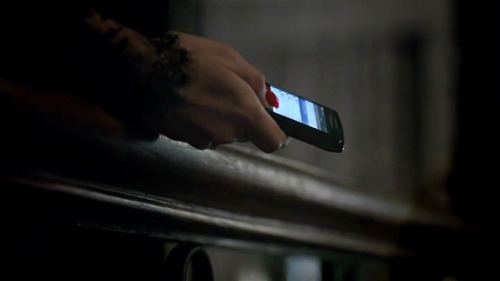
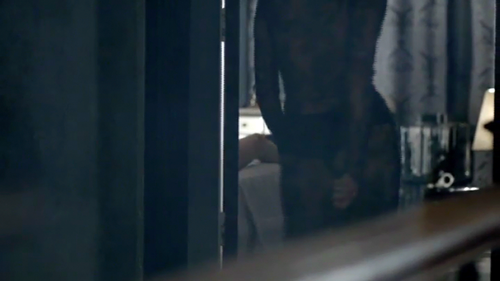
The first glimpse we have of Irene is her hand on her phone, where she keeps all that dangerous information, and then her negligéed ass walking toward a certain royal female person.
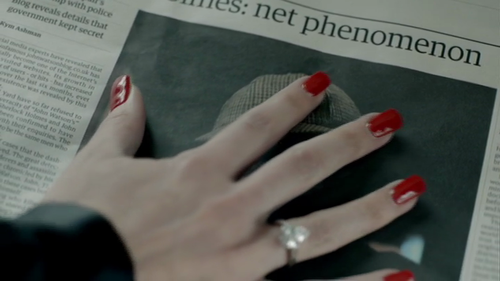
So this is Irene’s power at the start: information, and sexual agency. (To wit: information about sex.) In this she challenges Sherlock: in an early image we look at a photo of him in his fame and deductive power, and at her hand in its beauty and sensuality, covering up his face.
“I’m going to get you,” that hand says. (Yep, it’s a gorgeous object—but note that hands are also symbols of selfhood and agency, for they are how we manipulate, use tools, and touch.)
Visual Pleasure and Narrative Sherlock
(These are notes from a lecture I gave a year ago to an intro media class, part of an introduction to the concept of the cinematic gaze. We were working with the basic ideas from Laura Mulvey’s “Visual Pleasure and Narrative Cinema,” specifically, that women are the erotic objects of the gaze in cinema, both of the audience and the characters on screen, and that men are the bearers of the gaze, owners of the pleasure, knowledge, and power it gives. Men look, women are looked at: the camera looks with the eyes of a het man, and the audience looks with the eyes of the camera. Sherlock turns out to be an interesting test case for these ideas. As both the object of the erotic gaze and the subject of the knowing one, he puts a spin on Mulvey’s model. Please note that people have critiqued and developed these ideas a whoooole lot since she wrote; again, this was an explanation and illustration of the basic questions. And I’m pretty sure mid0nz has made similar observations; check her metas for more.)
Part One: Watching the Detective
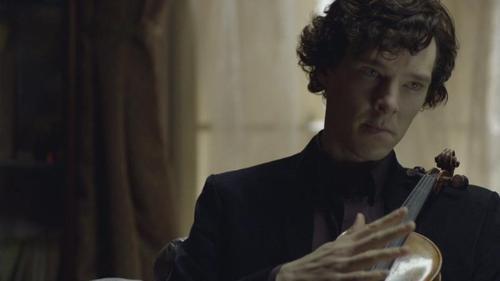
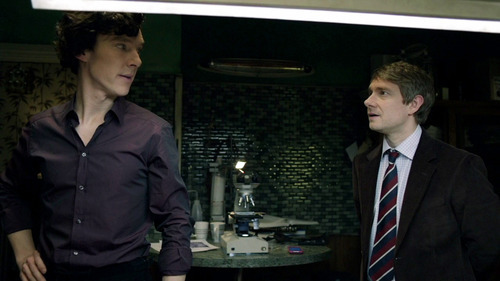
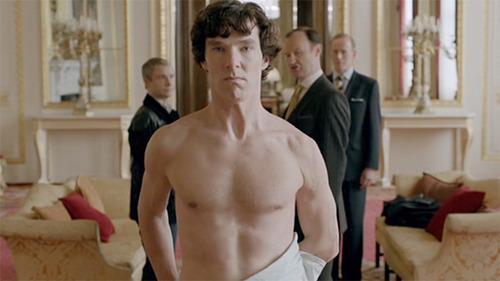
Like any detective story, Sherlock is all about looking: “you see, but you do not observe.” It’s all about the knowing gaze, the desiring gaze—the gaze that desires to know. Within the story, Sherlock’s the bearer of this observant look, and it’s his searching scrutiny that moves the narrative along. But the most frequent object of the viewer’s gaze isn’t the crime or the criminal, it’s Sherlock himself. The camera almost begs us to look at him, especially when he’s deducing. In “A Study in Pink,” Paul McGuigan uses a great many of the techniques that have traditionally been used to make women the object of visual pleasure in film to focus us on Sherlock and make us enjoy the view. The camera makes sure we take pleasure in looking at him. He’s continually foregrounded, beautifully dressed and lit, looked at by others (mostly men) on screen, and sometimes just straight-up sexualized.
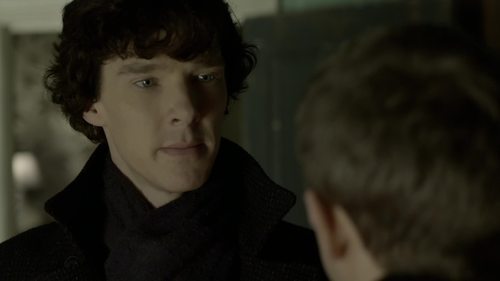
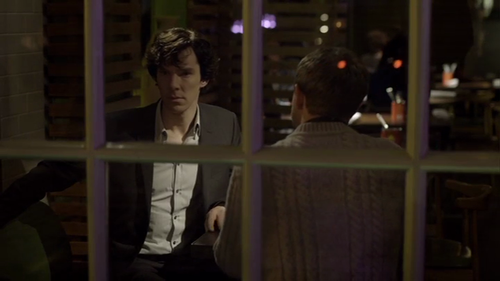
As we see in the last image, McGuigan also cues us to look at him with others on screen. In one of his favorite framings, we look at Sherlock with John, over John’s shoulder. (John, like ACD’s narrator Watson, is our point of identification within the story, the mediator between us and Sherlock. We see—and love—Sherlock along with John.)


Okay, but guys lets think about things a little bit, shall we?
Dean was still at the house when Nora arrived home at the end of the episode, She didn’t seem mad or put off by the whole ‘strange man in my house’ thing which means she had to come up with a logical explanation as to why Dean was there. I mean Cas kind of explains it, Dean knew how to bring the baby’s fever down, but he didn’t need to physically come to the house in order to tell that to Cas.
SO, I propose, that after seeing Dean and Cas together there’s no way Nora wouldn’t have picked up on the ex-lover vibes they were giving off all episode.
I think Nora thought Cas was gay, like right from the start. It would explain why she kissed him so casually and didn’t think anything of it and it would explain why she asked him in babysit in such a confusing way. She didn’t expect Cas to be interested in her so her wording was like she was speaking to someone who knew what she was talking about from experience – ‘it’s so hard to meet a good guy’.
Seeing Dean and Cas together, even if they were acting like exes that were seeing each other again for the first time after the break up, their connection would’ve been obvious and just confirmed what she thought.

GWEN COOPER META PLEEEASE, extra points if you discuss her role as torchwood’s coprotagonist!
well tbh i would argue that gwen is the protagonist, much to the dismay of the anti_gwen_allies
like Rose, we see things very much through her eyes, and we discover the world of torchwood through her. despite us already being familiar with jack from S1 of DW, he is presented as a mystery to us in the first ep because we are going along with gwen and discovering things as she does.
i love gwen cooper so much. i like that she is the heart of the team, but she can still be selfish, manipulative, immature and make mistakes. i’m not a particular fan of the owen/adultery subplot (and because i saw S2 first it didn’t really influence my feelings towards gwen which were already solidly positive by the time i watched S1. and a large percentage of how much i love characters is down to how good their actor is and eve myles is fantastic and has a great range, so even if a character does shitty things i’ll still love them if it’s well played), but even that shows that she is fallible and human. for real, how many people would use a memory erasing pill if their partner found out they cheated on them? quite a lot i would say. you might not like it, but it’s realistic. i like that she’s allowed to be funny, actually properly funny, she cracks jokes and is generally a very positive person and can make light of a bad situation. i like that she’s allowed to be violent, that she can rock a huge bazooka, but still be a loving wife and mother and still care about people. she even has a little pair of protective ear muffs for when she’s shooting near anwen!
i like how she teaches the team, and jack in particular, to be less cold/methodical and think about the people they are affecting with their work. she makes them more human, but ironically as the show goes on she becomes more bitter and detached as the people she cares about are cruelly ripped away from her until it culminates in that scene in Miracle Day:
Because you know what the worst thing is of all? Of all the shit we have seen, all the bloodshed, all the horror- do you know what is worse than all of that? I loved it. I bloody loved it. And I’d keep telling Rhys I was sorry, and I’d say to little Anwen I’m sorry. But I loved it so much.
I knew things no one else knew and, oh, I felt so special. And when we lost people, it was so so big. And I could say it was worth it. ‘Cause the bigger it was, the more important I was. And the more people we lost, the more that meant I was a survivor and I was better than them.
Asphodel and Wormwood: occupyvillengard: merindab: I love tumblr. I’m involved in a…
Asphodel and Wormwood: occupyvillengard: merindab: I love tumblr. I’m involved in a…
I love tumblr. I’m involved in a discussion over which Harry Potter house Ianto Jones would belong in. I’m leaning towards Slytherin myself.
I’ve been trying to work this one out myself – I think it’s rare to come across someone who could fall neatly…
Everything you’ve said makes sense and jives with canon, but I can’t help but wonder – are their Slytherin qualities part of their natural temperaments, or learned behaviours because of their circumstances?
Jury’s still out on Ianto, I could still see that going either way for him. But Jack’s never been so much about ‘by any means necessary’ as ‘because I have to and if I don’t people will die and the world will end and I’m shit out of luck/hope/better options/time to come up with them’. There seems to be an overriding duty to ‘the greater good,’ and I reckon that’s a different kind of Gryffindor thing – that was a Dumbledore thing, for a while, wasn’t it? Never mind the fact that if Jack had the same unbending convictions as Gwen and Rose, planet Earth would be doomed and he knows it. And sometimes his decisions are all the more awful as a result of his brashness and unwillingness to consider that he might be in the wrong – again, seems like a Gryffindor quality from my angle. And you said yourself, Jack wants to be a Gryffindor. He wouldn’t be the first to make that choice over Slytherin – and it’s our choices, not our abilities, etc.
Is Ianto naturally ambitious, ruthless, cunning, and selectively loyal? I think so, yes. A boy from the Cardiff estates doesn’t make it all the way to Torchwood One in London without those qualities, and he doesn’t keep his half-converted girlfriend in Torchwood Three’s basement without them either. It is about choices, it is exactly about Ianto’s choices: he chose to work for Torchwood, he chose to pull Lisa out of the wreckage instead of letting UNIT finish cleaning up, he chose to lie repeatedly to Jack, to continue working for Torchwood even after Lisa’s death, to open the rift for a chance at getting Lisa back. None of those choices had to do with saving the world, and a few of them actively endangered it. All of them were in some fashion selfish choices. Slytherin choices.
Jack is murkier, I will agree with you there, and there is no doubt in my mind that post-Doctor Jack would ask the Sorting Hat to place him in Gryffindor, but Jack can still be overwhelmingly ruthless, unethical, and selfish, and though his decisions often come down to “the greater good” and what must be done to save planet Earth, they also often don’t.
The manipulative things Jack does are not always about saving humanity (and even when they are, they could stand a good shot of ethics and still end up keeping the planet intact). He keeps his past hidden even when hiding it puts his team directly in danger (John Hart, Exit Wounds), he keeps his team isolated and small because he has such a desperate need to control his surroundings and those he loves, even though that understaffed isolation is mostly what gets them all killed, and clearly keeping Torchwood a “secret” is only at issue when he wants it to be, not because it serves any greater purpose, and even when retconning someone is the entirely wrong thing to do outside of that.
Jack is a Slytherin with a Gryffindor coat of paint, and his coat is perpetually wearing thin.
(Albus Dumbledore is a whole new post unto himself, but I will say that he strikes me as a bit more Slytherin than anyone would like to admit. The difference is that after Grindelwald, Dumbledore is almost never doing his manipulating for selfish reasons. Often, Jack is.)
Just wanted to point out that Ianto doesn’t open the rift to get Lisa back. At no point is it ever suggested that if he opens the rift he’ll get Lisa back. Not even by Lisa vision.Lisa vision tells him that if he doesn’t open the rift thousands of people will die.I have a number of problems with Ianto in EOD, but wanting Lisa back and risking the world for that isn’t one of them.
LISA: Hello, Ianto.
VARIOUS FLASHES OF: [Scenes from 1X04: Cyberwoman] Lisa the Cyberwoman and Ianto crying.
End of flashes.(Lisa walks toward Ianto.)
IANTO: What do you want? Why are you here? This isn’t happening.
LISA: There’s only one way to stop this, before things get worse. People will die, Ianto. Thousands of people. Unless you open the Rift.
Also remember that in CJH despite whatever feelings Ianto has for Jack and whatever loyalties he has to Jack he’s prepared to leave both him and Tosh back in 1941 rather than risk opening the rift dangerously. So while Ianto is certainly loyal to the people he loves (and even then not really if he apparently believes there’s a better cause (see Adrift) by the end of s1 it’s not as simple as that. Even with Lisa in Cyberwoman I don’t think it’s as black and white for him as Lisa v. the World, but that’s a debate for another time lol.
Correction about Lisa accepted. I had Owen’s Diane issues in Captain Jack Harkness mixed up with the flashbacks in End of Days. My apologies.
However, everything else I mentioned stands, and I do think that Ianto’s refusal to allow Owen to open the rift in CJH is first and foremost out of his loyalty to Jack personally. Look at Ianto’s language during this episode (italics added for emphasis):
“Good. Jack would never have wanted us to use it this way.”
"You can’t open the safe. You’ve got no right.” […] "There’s stuff in there we don’t know about. That’s how Jack likes it.
“He’s our leader.”
“I’m much more than that. Jack needs me.”
Of course he’s also concerned with saving the world, as any right-minded person would be (Owen most certainly not being in his right mind at the time), but his first loyalty is not to the world as a whole but to Jack in particular.
If in Adrift you’re referring to Ianto giving Gwen information about Flat Holm against Jack’s wishes, I would point out that the group of people Ianto is specifically loyal to does include Gwen, and in this one case his loyalty to her along with his belief that she needs to know/won’t give up until she knows trumps his loyalty to Jack’s secret. I would also point out, however, that this may also stem somehow from his loyalty to Jack; he knows Gwen won’t give up, and he also knows that Jack can’t bring himself to tell her, so he’s done it himself, because in all honesty he’s better equipped to handle the emotional fallout than Jack. In either case, his actions are fairly Slytherin in and of themselves, and none of it has anything to do with any “greater good.”
I do rather think Cyberwoman is a case of Lisa v. the World, actually. Ianto knows that, were she to fully convert, Cyber-Lisa would destroy the world, and there are no foreseeable benefits for the world at large if she’s cured other than an escape of utter destruction, which would be served far better by her immediate destruction. Yet, he keeps her alive, in Torchwood Three’s basement, right under Captain Harkness’ nose, for months. That sounds exactly like Lisa v. the World to me, and in Ianto’s mind, Lisa won.
It’s never made clear what Ianto’s agenda is in Adrift. He’s more of a catalyst for Gwen and Jack’s plot than a character with his own distinct motivations. It could be loyalty to Gwen, it could be loyalty to Jack or it could be that for some reason never explained he thinks it’ll benefit the people at Flat Holm. Or even none of the above.
I think Lisa is a very personal issue for Ianto, but I also don’t think it’s as simple as Lisa v. the world because I don’t think Ianto’s thinking about the potential threat to the world at all. I don’t even think he considers Lisa as a potential threat until she becomes a threat. If anything before that it wouldn’t surprise me if he considers the world more of a threat to her than her to the world because until the Doctor ‘fixes’ her she’s the vulnerable one. She can’t move or breathe without help, she’s in pain, she’s not even in a real position to stop someone from man-handling her if they want to, she’s utterly dependent on him and to all intents and purposes, at least, from what we’re shown, she still seems to have Lisa’s rather than a cyberman’s mind. But I also think Lisa is pretty much the last time the personal is so absolute for him to the exclusion of all else. I don’t think we see that CJH and I don’t think we see it in EOD. Of course saving the world is what a thinking person would do, but the point for me is it never becomes a choice between Jack or the world for him. If he can save Jack and Tosh then fine if not they’re never his priority the way Lisa is in Cyberwoman and (at least for this episode because Torchwood and continuity past each respective episode is kind of a crap shoot) I think that’s the point because Lisa is supposed to be a lesson learned for Ianto. One he tries to impact to Owen when he goes doollally over Diane . Of course it’s hard for me to say much about s2 because the only other time they have any real conflict is when Ianto goes against Jack in Adrift and like I said he’s really not given much of a motive beyond moving Gwen’s plot along.
It is true that we aren’t explicitly given Ianto’s motivations in Adrift, so I suppose he could have done it because he somehow believed it would be good for the patients at Flat Holm, but it seems to me that, given the general trend of Torchwood employee behaviour and Ianto’s tendencies to act more out of loyalty to those he cares about than out of vague impulses to save strangers (and one wonders what he could have possibly thought they’d get out of Gwen knowing about them that they weren’t already getting from only Jack knowing about them), the possible motivations I cited above are far more likely.
As for those tendencies of Ianto’s, I already cited multiple quotations supporting my belief that Captain Jack Harkness does show Ianto’s specific loyalty to Jack as leader—which is this case manifests as not opening the rift irresponsibly, because “Jack would never have wanted us to use it this way.” (Incidentally, I don’t think he gives much of a damn about “imparting lessons” to Owen at this point, as evidenced by his shooting Owen in the shoulder rather than calmly talking him down.) He does desperately want to get Jack and Tosh back, but he isn’t willing to go against Jack’s wishes to do so, not because opening the rift is dangerous (although it is and he knows it, and no one is ever going to argue that he isn’t far more emotionally stable than Owen), but because Jack said not to do it.
End of Days, rather than disproving that loyalty to Jack, simply asserts that his loyalty to his teammates and to Lisa’s memory collectively is strong enough to overcome it when coupled with the threat of imminent global doom. Vision Lisa does tell him that thousands of people will die if he doesn’t open the rift, rather than promising that he’ll get her back, it is true, but it is also Lisa telling him this, and his teammates are absolutely certain this is the right course of action, and he’s terrified the world is ending (let’s not forget that self-preservation is one of a Slytherin’s most important instincts), so he decides in this one case that Jack is wrong. That doesn’t disprove his loyalty to Torchwood specifically over any kind of moral or ethical stance.
Even if Ianto didn’t believe Lisa was a threat (or more probably, was doing his damndest to convince himself she couldn’t possibly be a threat), he witnessed Canary Wharf. He watched his friends and coworkers being converted, watched them die, watched as UNIT killed the converted or partially-converted in the aftermath who weren’t quite dead yet, watched his whole life go up in flames in the space of a few hours. He knows that Cybermen could wipe out the universe, and he knows that Lisa is partially a Cyberman. He chooses to sneak her out of Torchwood One under UNIT’s nose, to sneak her into Torchwood Three under Jack’s nose, and keep her a secret for months. He also chooses to hide the body of Dr. Tanizaki after Lisa kills him, at which point he must know that she is dangerous, even if he had no inkling before. In short, he chooses to protect her rather than letting UNIT kill her, letting Jack know about (and kill) her, or even telling Jack about her after she has attempted to convert and killed a man in cold blood.
It’s all personal for Ianto, either out of loyalty to those he loves or for his own gain. He endangers the world, lies to multiple government agencies, lies to Jack, lies to his enemies, lies to his friends, threatens to torture John Hart to death (Exit Wounds), attempts to kidnap his niece to perform experiments on her, and shoots Owen in the shoulder, to name but a paltry few examples, and none of that, to return to the original argument, sounds like anything a Hufflepuff would ever do.
I love talking about the ‘old days’ of hunting. I think it’s a credit to the show that the concept is even possible. Also, as I’m slightly older then probable average tumblr user, I do actually remember at least the 80s and what life was like pre-internet. I think that’s part of why I like writing stories about young sam and dean; I am Dean’s age. Of course I’m missing 5 seasons of the show but at least I have the bones.
YES! I think that the good old days would be fascinating. And the fact that we get to travel in time and see things like Mary and John in their younger years. I mean, Mary was a kick-ass hunter when she was younger; John was a former Marine. Had they combined their skills and knowledge and taught their kids how to hunt in a safe, kind environment, who knows what would have happened to the boys.
I also adore thinking about things like, life before the Internet, cell phones, etc. I think it might be interesting for younger viewers watching seasons where the boys have to hang out at the library for an entire afternoon researching a small town. They had to actually travel to the town in order to access their resources and then decide, yes there is a case, no there isn’t. I bet a lot of trips were made that ended up in frustration.
And I think we get a taste of this in probably the first three seasons the most; where we see the boys following closer to what was written in John’s journal. I mean, they boys also talked about being left behind in certain areas for extended amounts of time. John’s gotta drive probably 8 or so hours, spend a day or two doing research, spend a day with the local authorities, spend a day or two hunting, and then drive back. Like, a legit hunting trip would have taken a week, minimum. While he’s out there, it would be so much easier for him to have just gone “oh, I’m only 4 hours away from what could potentially be this other lead on Yellow Eyes and there’s some suspicious something-or-other happening only 2 hours east of here, so I’ll just hang out around these parts for a few more days and see what I can find out.” What John saw as research for vengeance, the boys would have seen as potential abandonment.
The boys, comparatively, have it easy. They have smart phones; so many cities and towns have online archives of their newspapers; they have Sam’s magical wifi capabilities. They have the bunker. They had Bobby and now Garth. They had Ash.
I think this is a fascinating subject. I would love to know more, especially comparing the Campbell family and the Winchester family, traditional hunters versus Men of Letters. I want to see how their styles would be. Can we just have like history books?