I went to see a talk by the Colin Gibson,
the production designer of Mad Max: Fury Road, and one of the most mind-blowing
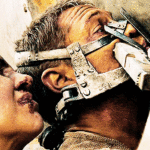
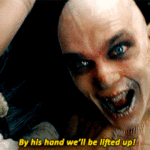
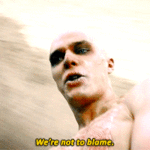
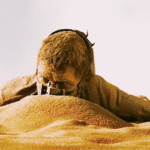
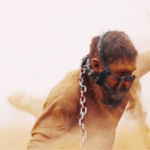
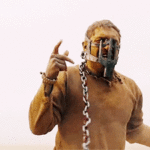
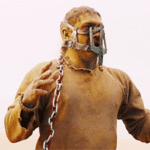
tidbits I learned was that when the Green Place turned sour, the matriarchal Vuvalini took their girls and fled, but they left all the boys behind. Those boys, left to die in the poisoned bog, became the Crow People we see walking on stilts:
Gibson also said they chose white paint for Immortan Joe’s war boys because
(and I quote) “fat white bastards killed the world.” The Vuvalini were
conceived as the opposite extreme to this, the opposite of the “fat
white bastards” – but their way and their culture is still a dead end, and their callous disregard for male children is no better than Joe’s callous disregard for female children.
This makes the ending of the film, where the wives and Furiosa take the Citadel in order to build a new society, even more important. Neither Immortan Joe nor the Vuvalini had the correct ideology, but the wives and Furiosa do. Thanks to their long journey in the Wasteland, they are placed in a position to fashion and rule a more idealised, peaceful society, one based on equality across race, class and gender.
Dag, the pregnant pacifist, took the seeds from the older, violent generation so she could build a new, peaceful one. Capable showed empathy and kindness towards Nux even though she had been abused by men her whole life, and will surely show the same empathy to the war boys and war pups left behind. Toast the Knowing, observant and intelligent and ready to lead, took the wheel from the dead tyrant at the end and eagerly helped raise up the oppressed classes at the Citadel. Cheedo the Fragile turned her fragility into her greatest strength, proving that gentleness is not weakness in this barbaric world.
Furiosa forged a relationship of complete respect and equality with Max that helped her overcome the trauma she suffered at the hands of men. She achieves catharsis by killing Joe and loving Max and the wives, emerging from it all ready to begin again, ready to leave the past behind and step into the future.
We see many different tribes and cultures in this film and are presented with many different methods for survival, but only one that is really worth fighting for. The love, trust, respect and equality that exists between a ragged band of strangers in a War Rig thus becomes the prototype for the new society that will rise from the ashes when the Citadel falls.
Max: You done this before? Furiosa: Many times. Now that I drive a War Rig, this is the best shot I’ll ever have. Max: And them? Furiosa: They’re looking for hope. Max: What about you? Furiosa: Redemption.
Er pardon my butting in and also deletion of the convo because long but also because almost none of the above was my stance on this scene in the movie, because of the essential factor that neither of them are nice people and are both positioned as anti-heroes in the narrative/themes and also that despite their working together there’s still elements of trust missing (that I think people forget because of fanon), but also things they can’t flat out say, being the people they are.
I feel like their conversation really goes, taking in all the context, their tones, their face, and their body language:
Max: Can I trust you to get to this place?
Furiosa: Yes, even though I haven’t succeeded before.
Max: Why did you bring them along even though they’ve probably brought the war parties down on your head? Thought you wanted the ‘best shot’.
Furiosa: because they asked, and I couldn’t refuse them with the way they asked. They still believe in hope.
Max: Do you still believe in it?
Furiosa: I don’t think I can. I’ve seen/committed too many terrible things and I want it to stop weighing on me.
And what’s key here is that Furiosa spends all of this conversation with a thousand yard stare. She’s throwing off ptsd like paint fumes, her mouth is held in that way reminds me of the way people hold it when they don’t want it to shake visibly shake.
Watch/Listen to the delivery of Max’s lines. “How do you even know this place even exists” is delivered with actual doubt, ”Then why’d you leave?” with confusion, and everything else is like… gentle, after she says “stolen, as a child.”
Compare his delivery of “How do you even know this place exists?” with “You done this before?”
And then how he keeps on looking at her until she says Redemption and then how he looks away.
This to me was a great scene of talking around things, there are things that Furiosa would never say to Max like the line, “I used to be a wife.” But she says it here in a way that had Max changing his tone with her instantly.
The information in this scene was almost completely stripped from the dialogue itself, like much of the movie, it’s all visual and tone and context, and I can’t watch it some days because I can’t watch the trauma on her face and on how she holds her mouth like people hold it in that careful way when they are in public and can’t cry.
This is really enlightening. Thank you! I mean, I got kind of the gist of all that, but not parsed out so clearly.
Being who I am though, I still can’t figure out where/how the ‘many times’ fit(s) in. In the conversation you present, is it essentially the part that says ‘I can get us there/you can trust me to get us there’? Is she essentially posturing then? Because she really hasn’t been there in a long time, so it can’t mean ‘i’ve been there many times already’
Sorry I’m so damn pedantic; I just get really stumped. It takes the movie from being this perfect masterpiece where everything fits into place and has meaning, to this one piece of the puzzle not fitting. I am wholly willing to believe that it’s some lack in my understanding that makes the piece not fit. In fact, I can’t help but think it really does! And that drives me crazy, because I hate being clueless bout something I feel I should ‘get’
I think she might have tried? I honestly don’t get too hung up on it; she says it lightly in a way that I honestly wouldn’t be surprised was posturing, at least to a degree because it clearly hadn’t worked before.
I put it in the same category as the milking mothers, logistically it doesn’t make the greatest of sense but it works as a theme and we might get more details in future movies.
This is a better analysis of this scene than what I had going on tbh, because it gets to the heart of what the scene is about, rather than what the characters are saying.
When there are enough women in your cast, not every woman has to represent all women and they can have individual flaws and strengths.
When there are enough women, some can fall apart and others can hold things together.
When there are enough women, you can literally name a character Cheedo The Fragile without making a statement about feminine fragility.
When there are enough women, you know the action movie doesn’t have to preserve the one woman in order to ensure you have one woman left in your cast at the end, so women might die, just like men, and the stakes are high and real and the plot is not predictable.
When there are enough women, you can cast women with different ages and looks and body types based on what makes sense for the story – beautiful women who were selected for beauty by a character who valued women’s bodies more than their whole selves, wiry muscular women of middle and older age, built to survive, mothers who were used for the things that come with their fertility and have the fat to show for it, old fragile women who took care of others while rarely stepping outside, disabled women affected by their environment and experiences.
When there are enough women, the world feels real.