



Just another WordPress site
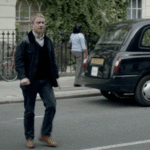

Anthea’s expression is the BEST.
She’s just like, “Oh John. Look at the newbie. Bless. You’ll get used to it, honey.”
(Alternately, she’s like, “God, I really am not paid enough to put up with these people. Mr. British Government, Sir, I want a raise.”)

Countdown to S’3 meme: 9 days to go!!!
(22) Character that you wish you could be ♥ John Watson
i feel like john just wants to feel normal but doesn’t realize that doing normal things actually doesn’t give him that, it just makes him discontent and his discontent makes him realize how not normal he is, whereas when he’s with sherlock, john is the normal one by default so like it’s the only way he can actually feel like he’s as normal as he wants to be
caitlinispiningforjohnlock-deac:
I’m going to try really hard not to be snippy or sarcastic here, I promise.
John watched Sherlock commit suicide IN FRONT OF HIM and believed it was because he was about to be unmasked ‘as a fraud.’ He believed this for TWO YEARS. When Sherlock comes back John tells him he wants to know not how, but why.
But knowing the why doesn’t mean those two years didn’t happen! It doesn’t undo the trauma or the betrayal. it’s not a “Oh, well, no harm no foul!” kind of situation, is it? Expecting John to just instantly get over that depth of devastation isn’t just unreasonable, it would be truly crap writing and characterization.
(Also, honestly struggling with forgiveness isn’t the same as ‘blaming the victim.” )
In addition, however, I also take some issue with characterizing Sherlock as a ‘victim’ in this scenario. There were many, many points he could have done things differently. He WANTED a confrontation with Moriarty. He CHOSE a confrontation with Moriarty over preserving his relationship with John.
Sherlock and Moriarty are presented as equals. To think that Sherlock didn’t get a rush from being cleverer than Moriarty is to not fully grasp the motivations of Sherlock Holmes. Painting Sherlock as Moriarty’s ‘victim’ is doing Sherlock a grave disservice.
Out of many possible choices, Sherlock made the decisions that funneled the possible outcomes down to the confrontation on the roof.
He did what he did to save his friends, yes, but Sherlock also chose to fake his own suicide because it was incredibly clever.
This mix of motivations is why the ‘why’ is important to John, and why Sherlock is genuinely remorseful in S3. His decisions were a tangled mix of altruism, thrill-seeking, protectiveness, and showing off. Exactly like Sherlock himself.
In the end, the road of finding true forgiveness and acceptance is hard, bumpy, and filled with emotional nuance. Why would anyone not want to see that amazing journey?
Also, John doesn’t have to forgive Moriarty, does he? He can happily hate and revile him ‘til the end of time. That’s easy.
In a very simple sense, something I say to my children every day, saying sorry doesn’t make it not hurt.
Sherlock isn’t a victim, and I don’t blame him, so neither descriptor is accurate. I love Sherlock. I love him, and I sympathise with him, and I want him to have all the happiness in the world with John, because I feel they both deserve it. But recognising his flaws is healthy and we should all, as intelligent fans, be able to recognise that both Sherlock and John make some really terrible decisions. Especially where it concerns each other.
Sherlock deceived John not just in ONE singular moment, but for two years. That’s a lot for anyone to forgive.
Everything both these smart people said is dead on.


Indeed, as reimagined by Steven Moffat and Mark Gatiss, Watson is a veteran of the war in Afghanistan, so Freeman immediately envisaged him as someone who is ‘strong and silent and [has] nothing unnecessary about him—no fat, no extras, no vocal flourishes, no physical flourishes. He’s a man’s man. He has weight because of his experience in life and death.’