




Just another WordPress site
No matter how much you shame and scare them, women will still come for abortions. Pretty recently I had this young woman, 15 maybe, and we did the procedure. I said, ‘Your uterus is empty, the procedure is over. I have to go check to make sure we got everything,’ and I left the room to examine the tissue. Then I came back and told her, ‘Everything’s fine, your uterus is healthy.’ And she said, ‘So … when are you going to use the steel ball?’ I picked my jaw up off the floor and said, ‘Steel ball?’ She said, ‘Well, I went to the crisis pregnancy center and they told me you’re going to put a steel ball that’s covered with sharp blades into my uterus and twirl it around.’ And this kid still came! I was thinking, How did you ever make yourself walk in the office believing I was going to do that?
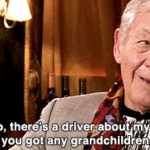
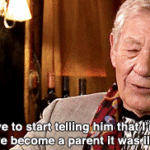
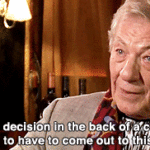
How most people with invisible illnesses are treated by health care “professionals”
The Golden Girls didn’t fuck around
pls watch
honestly i really appreciated this scene when I first saw it bc it took me like two years to get a diagnosis for what’s wrong with me
Dorothy: Dr. Budd?
Dr. Budd: Yes?
Dorothy: You probably don’t remember me, but you told me I wasn’t sick. Do you remember? You told me I was just getting old.
Dr. Budd: I’m sorry, I really don’t–
Dorothy: Remember. Maybe you’re getting old. That’s a little joke. Well, I tell you, Dr. Budd, I really am sick. I have chronic fatigue syndrome. That is a real illness. You can check with the Center for Disease Control.
Dr. Budd: Huh. Well, I’m sorry about that.
Dorothy: Well, I’m glad! At least I know I have something.
Dr. Budd: I’m sure. Well, nice seeing you.
Dorothy: Not so fast. There are some things I have to say. There are a lot of things that I have to say. Words can’t express what I have to say. [tearing up] What I went through, what you put me through—I can’t do this in a restaurant.
Dr. Budd: Good!
Dorothy: But I will!
Dr. Budd’s date: Louis, who is this person?
Dr. Budd: Look, Miss–
Dorothy: Sit. I sat for you long enough. Dr. Budd, I came to you sick—sick and scared—and you dismissed me. You didn’t have the answer, and instead of saying “I’m sorry, I don’t know what’s wrong with you,” you made me feel crazy, like I had made it all up. You dismissed me! You made me feel like a child, a fool, a neurotic who was wasting your precious time. Is that your caring profession? Is that healing? No one deserves that kind of treatment, Dr. Budd, no one. I suspect had I been a man, I might have been taken a bit more seriously, and not told to go to a hairdresser.
Dr. Budd: Look, I am not going to sit here anymore–
Dr. Budd’s date: Shut up, Louis.
Dorothy: I don’t know where you doctors lose your humanity, but you lose it. You know, if all of you, at the beginning of your careers, could get very sick and very scared for a while, you’d probably learn more from that than anything else. You’d better start listening to your patients. They need to be heard. They need caring. They need compassion. They need attending to. You know, someday, Dr. Budd, you’re gonna be on the other side of the table, and as angry as I am, and as angry as I always will be, I still wish you a better doctor than you were to me.



well for one you’re assuming that a cell phone is a luxury. My house hasn’t had a landline since I was 14 because it was less expensive for my mom to have a cell phone. It’s still less expensive per month for my mom and I to have cell phones and internet than to have a landline and internet. Also, for a working parent to not have a cell phone is ridiculous. How else is their child supposed to get ahold of them reliably during commutes??
secondly, do you realize how inexpensive it actually is to get an iPhone?? I’ve had two different ones over the years (a 4 and a 5C) and they were 100% free with my contract renewal. I’m planning on getting a 6 in the fall with my rewnewal for… you guessed it 100% free. A lot of jobs have discount purchase programs for employees or even gift their employees a work phone.
You also have no right to say what somebody is allowed to spend their expendable resources on. They might have saved up for months and months to afford the phone. They might have scraped together every last penny after bills and rent and groceries, skipping a dinner with a close friend, not replacing their worn shoes, to save up for this one thing that they really wanted. Why? Because people like you make needing help a shameful thing so they might want to hide behind a symbol of wealth so they don’t have to find out which of their friends would laugh at them if they found out (which has happened to me). Or, maybe, just maybe, because absolutely everybody deserves to have nice things that make them feel good about themselves and if its a phone then so be it.
And other thing: do you know what is a really practical gift for an older parent to give their struggling adult child? A reliable cell phone. Say what you want about Apple but they’re pretty reliable (if you don’t drop them).
You are judging people based on superficial details without knowing their stories.



It’s like this…
You’re fourteen and you’re reading Larry Niven’s “The Protector” because it’s your father’s favorite book and you like your father and you think he has good taste and the creature on the cover of the book looks interesting and you want to know what it’s about. And in it the female character does something better than the male character – because she’s been doing it her whole life and he’s only just learned – and he gets mad that she’s better at it than him. And you don’t understand why he would be mad about that, because, logically, she’d be better at it than him. She’s done it more. And he’s got a picture of a woman painted on the inside of his spacesuit, like a pinup girl, and it bothers you.
But you’re fourteen and you don’t know how to put this into words.
And then you’re fifteen and you’re reading “Orphans of the Sky” because it’s by a famous sci-fi author and it’s about a lost generation ship and how cool is that?!? but the women on the ship aren’t given a name until they’re married and you spend more time wondering what people call those women up until their marriage than you do focusing on the rest of the story. Even though this tidbit of information has nothing to do with the plot line of the story and is only brought up once in passing.
But it’s a random thing to get worked up about in an otherwise all right book.
Then you’re sixteen and you read “Dune” because your brother gave it to you for Christmas and it’s one of those books you have to read to earn your geek card. You spend an entire afternoon arguing over who is the main character – Paul or Jessica. And the more you contend Jessica, the more he says Paul, and you can’t make him see how the real hero is her. And you love Chani cause she’s tough and good with a knife, but at the end of the day, her killing Paul’s challengers is just a way to degrade them because those weenies lost to a girl.
Then you’re seventeen and you don’t want to read “Stranger in a Strange Land” after the first seventy pages because something about it just leaves a bad taste in your mouth. All of this talk of water-brothers. You can’t even pin it down.
And then you’re eighteen and you’ve given up on classic sci-fi, but that doesn’t stop your brother or your father from trying to get you to read more.
Even when you bring them the books and bring them the passages and show them how the authors didn’t treat women like people.
Your brother says, “Well, that was because of the time it was written in.”
You get all worked up because these men couldn’t imagine a world in which women were equal, in which women were empowered and intelligent and literate and capable.
You tell him – this, this is science fiction. This is all about imagining the world that could be and they couldn’t stand back long enough and dare to imagine how, not only technology would grow in time, but society would grow.
But he blows you off because he can’t understand how it feels to be fourteen, fifteen, sixteen, seventeen and desperately wanting to like the books your father likes, because your father has good taste, and being unable to, because most of those books tell you that you’re not a full person in ways that are too subtle to put into words. It’s all cognitive dissonance: a little like a song played a bit out of tempo – enough that you recognize it’s off, but not enough to pin down what exactly is wrong.
And then one day you’re twenty-two and studying sociology and some kind teacher finally gives you the words to explain all those little feelings that built and penned around inside of you for years.
It’s like the world clicking into place.
And that’s something your brother never had to struggle with.
This is an excellent post to keep in mind when you see another recent post criticizing the current trend of dystopian sci-fi and going on about how sci-fi used to be about hope and wonder.
No. It used to be about men. And now it’s not.
Tell us again why equality in spec fic doesn’t matter. We dare you.
Why the dismissal of women’s readings of Sherlock bothers me so much
Male showrunners and actors: They’re just friends. Why are you reading sex into this?
Female fans: They obviously want each other.
Male showrunners and actors: No they don’t. You’re hysterical and oversexualized and deluded.
Female fans: No we’re not. It’s OBVIOUS they desire each other.
Male showrunners and actors: NO THEY—
Female fans: YES THEY—
[ad infinitum]
Film and television are visual mediums. The text comes from what we see, not just the script, and definitely not extra-text commentary. Sherlock especially is a strikingly visual story that is all about looking.
Any woman with any sense of self-preservation spends her whole life learning to read the male gaze. The reason is not because women are constantly checking to make sure they are desirable (as many men like to think); the reason is because women have to. The consequences for not noticing when a male gaze equals “desire” are very dangerous, and so obvious I don’t even have to explain them. Any woman who walks through a parking lot at night, who has to spend her days avoiding a co-worker who sexually harrasses her but not enough to make it worth it to fight back, who deals with members of the public service who laugh at her when she is being threatened (I am thinking of that woman in San Francisco who tried to get a BART bus driver to call the police when a man was threatening to rape her and got ignored)—any woman who LIVES ON THIS PLANET has to learn to be aware of the male gaze and interpret it for signs of arousal and/or danger from a young age. This is SO MUCH BIGGER than “women want romance” or “women want love” or any of that ignorant shorthand for “women aren’t reading this show correctly.” It is definitely bigger than Sherlock.
If a man stood right in my personal space and stared into my eyes I would know how to interpret that. If a man licked his lips while staring at my face I would know how to interpret that. If a man belitted and chased off my romantic partners I would know how to interpret that. If a man asked me to reach into his jacket and pull out his phone I would damn well know how to interpret that. Any time I have tried to brush aside suspicions under these circumstances, I was proved right that I should have trusted my instincts, and I wound up in dangerous situations (luckily, nothing terrible resulted thanks to being able to escape, but the danger was real). If I’m wrong, I’m wrong, but at least I don’t get locked in a basement in Cleveland for a decade. Women have to err on the side of caution. People are right when they say the sexual tension moments in Sherlock are brief, but that doesn’t matter: if you’re a woman you have to take even the briefest flashes into account. There is a reason we call these moments “eyefucking.”
Sherlock is all about the power of sight, of the gaze, specifically the male gaze. (There’s a whole article in that, but I’ll resist.)
We get Sherlock POV when he interprets a scene, with those subtitles and graphics; we get John POV for everything else (that’s my reading, anyway; Watson is the narrator of the Sherlock Holmes tales, after all). There are only a few establishing shots/omniscient narrator scenes that aren’t from John or Sherlock’s POV, e.g. the victims at the beginning of ASIP, or Moriarty texting in front of Big Ben in ASIB or in a cell in THOB. We briefly see Irene’s POV as she looks at pictures of Sherlock (in that beautiful sequence where they look at pictures of each other), but that’s about it. (I’ve never been certain whether that dream sequence of Irene interpreting the “bed scene” was from her POV or Sherlock’s or both.) I have hopes we’ll see Molly’s POV in TEH but of course I haven’t seen it yet.
The denial of the male showrunners of Sherlock and the firm disagreement of the female fans just proves to me that even in the 21st century, men and women live in different worlds.
5 men: There’s no sexual tension.
Thousands of women: Yes there is.
5 men: Clearly you’re wrong!
I don’t need this ship to be canon, it’s not the differing opinions that bothers me. The writers are free to write whatever they want and I’m on board. I just want some acknowledgement—from the world at large—that women’s perspective on human interactions is just as valid as men’s and doesn’t come from wishful thinking. Quite the opposite.
Bottom bit bolded, because THIS. Fucking THIS, a thousand times THIS. It cannot be said strongly or loudly or often enough: we get so, so fucking tired of being told that we’re delusional, when everything – everything – is telling a different story than the ones TPTB think they’re telling.
Women are forever being told we’re imagining it all – from PMS to actual hostility and danger to narrative romance, and everything in-between. Women are always ‘imagining things’, and men are always there to set us straight. Well, fuck that.
I got an email from a reader earlier. The sender was a lovely young woman who had just re-read my first published fic and wanted to tell me how much she enjoyed it—how it made her feel, how it made her smile, how it made her cry, how it made her excited to get home each night and curl up in bed with it, how it helped ease the pain of a difficult patch in her life, and how much she misses it now that it’s over. It was a beautiful letter, and my reaction to it must have been visible enough to make my saner half take notice from across the room. He shot me a questioning look, and I turned the laptop around and gestured to the screen.
I followed his eyes as they scanned each line, saw his lips tip up in a smile that grew broader as he read, then braced myself for the good natured snark I’ve come to expect when my little literary hobby comes up in conversation.
“Wow.” He said. “That was kind of amazing. How does it feel to be someone’s favorite author?”
“Don’t be a dick,” I said, slapping him on the shoulder.
“I’m serious,” he replied, gesturing to the screen. "That’s what she said—right there: You’re my favorite author.”
“I think she means favorite fic author. Not real author.”
“Is there a difference?” He asked.
“Yes,” I said, rolling my eyes. ”Of course there is.”
“Why?”
“Because, as someone in this room who isn’t ME is fond of pointing out, self published gay mystery romance novels aren’t exactly eligible for the pulitzer.” I said, turning the computer back around.
“So what?” he shrugged, “Something you wrote inspired a stranger to sit down write what it meant to them and send it to you. A lot of total strangers, as a matter of fact. You write, people read it and react. That makes you an author.”
“Huh.” I said, very eloquently, then got up and went into the kitchen to start dinner.
Hours later, sitting down to reply to the letter in question I find myself writing this post instead. Because here’s the thing: That wonderfully crazy man who lives in my house is right. (But please don’t tell him I said that)
From the moment I realized that letters made up words and words made up sentences and sentences made up worlds that were mine to explore any time I wanted to I’ve been a reader. I have fallen in love with perfect phrases and epic stories and countless characters pressed between the pages of the thousands of books I’ve read in my life so far—and sitting down to string together those same 26 letters into tens of thousands of words of stories I felt needed telling? That makes me an author.
I have adored the work of countless authors in numerous genres, and the world of fan fic is no exception. I have admired and cherished and savored the words of talented writers whose work is no less legitimate for the fact that their names include random keyboard characters and their words don’t live on bound paper on a shelf.
It’s not JUST fan fic. It’s literature. It’s published. It’s read. It’s loved.
It matters.
Thanks to all of my favorite authors for every word on every page on every screen that I’ve ever loved.
Reblog for the sweet anon who asked me if I thought fanfic was as important as “real” fiction. Hope this answers your question. 🙂
Thanks for reading my work, so happy you’re enjoying In The Library!
Read this. Take it to heart. REMEMBER IT.
Comments are the best
They really are. Anything that manages to touch another person, make their life – their day, a particular minute – better is invaluable.
“Let us not desert one another; we are an injured body. Although our
productions have afforded more extensive and unaffected pleasure than
any other literary corporation in this world, no species of composition
has been so much decried. … There seems almost a general wish of
decrying the capacity and under-valuing the labour of the novelist, and
of slighting the performances which have only genius, wit, and taste to
recommend them.“–Jane Austen, defending that most reviled of genres: the novel.
As Joanna Russ says in How to Suppress Women’s Writing, “Jane Austen … worked (as some critics tend to forget) in a genre that had been dominated by women for a century and one that was looked down upon as trash, a position that may have given her considerable artistic freedom.”
This is us, now. This is fanfic.
Russ also writes that “women always write in the vernacular. Not
strictly true, and yet it explains a lot. It certainly explains letters
and diaries. … It explains why so many wrote ghost stories in the
nineteenth century and still write them.”As I’ve said before, what is more vernacular in the 21st century than ephemeral, fannish internet porn? This is us. We are part of the long tradition of women writing and being told their writing is not real and does not matter, that the things we love and value are worthless and foolish, for so long that we even begin to believe it.
Our work is real work. Our writing is real writing. Our stories matter. Our community matters. We are here, together, doing this thing. This is real life. This counts. If you write something on the internet, you write it in real life.
Fanfic matters. Fanfic is literature. Fanfic is literature that breaks the bounds printing technology and capitalism once imposed on the wide distribution of the written word. Copyright law, royalties, the logistics of producing and selling paperback books, none of those can touch the heart of what a story is. None of those make your story any less a real story that can really touch another person.
If anyone tries to tell you different, you can tell them Jane Austen begs to differ.


