
Just another WordPress site
The next time I see the “it wasn’t canon argument,” I’m going to run screaming at you with copies of the Criminal Law Amendment Act of 1885 and news articles detailing the treatment of convicted homosexuals in 19th Century England, and then continue screaming until you understand exactly what would have happened to Arthur Conan Doyle had he explicitly written Sherlock Holmes and John Watson as gay lovers.
So, I wrote this a bit cheekily last night, but now I want to expand on it with some actual facts. I see a lot of people saying, “Oh, back in the 19th century, Sherlock and John couldn’t openly be together.” And that’s true, but what’s at the heart of that sentiment is this one, “Arthur Conan Doyle couldn’t have written them openly together, because the general public would assume he was encouraging homosexuality, perhaps was even homosexual himself, and that would have been dangerous.” Here’s why.
In 1885, the British Parliament enacted section 11 of the he Criminal Law Amendment Act 1885, known as the Labouchere Amendment which prohibited gross indecency between males. It thus became possible to prosecute homosexuals for engaging in sexual acts where buggery or attempted buggery could not be proven. Note that they didn’t have to actually catch you in the act, they just had to suspect that you did it. During this time period, many notable men were prosecuted with disastrous results; Lord Arthur Chilton committed suicide after being implicated in Boulton and Park trial involving two transvestites and Oscar Wilde was sentenced to prison and hard labour after being found guilty.
Was there still a homosexual culture in England at the time? Yes, it was around this time that the movement began to flourish, with clandestine gatherings preceding the opening of the first gay pub, The Cave of the Golden Calf in 1912. There was even the beginnings of gay erotica and publishing, but it was still very much subversive and not openly distributed among the public.
The opposite of who Arthur Conan Doyle was; Sherlock Holmes increased subscriptions to The Strand magazine by 30,000. While Oscar Wilde, if not embraced, accepted, the consequences of his actions, Arthur Conan Doyle was not in a position to do that. He received a knighthood in 1902, he was involved in political campaigns and other civic work throughout his lifetime, and he had 5 children to support. He was not in a position to risk what an accusation of buggery would bring.
So, when you look at the situation, Arthur Conan Doyle was unable to go any farther than he had with Holmes and Watson in his original stories. Even if he wanted to. Even if he tried to fill it with as much subtext as possible, he would always have to be mindful of what would happen if he went to far.
This is why this argument bothers me so much. Were Sherlock Holmes in John Watson explicitly in a romantic relationship in the original stories? No, and no one is arguing that they were. Are we intended to imply, with the clues that were safe to include given the environment at the time, that it’s a possibility? That’s up to you to decide. But demanding that the only way a relationship could be legitimate is if it had been clearly stated by Arthur Conan Doyle is frustrating because it’s imposing today’s standards on a time period where they do not fit.



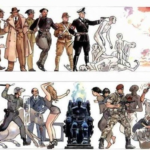
Things I learnt today: During WW1, MI5 used Girl Guides to send secret messages. They used Girl Guides because they quickly found that Boy Scouts couldn’t be trusted and were’t efficient enough.
“At the start of the war Boy Scouts were also used. But it quickly became clear that Girl Guides were more efficient because they were less boisterous and talkative.”
the boy scouts were too gossipy, so they used girl guides as spies instead this is probably the best day of my life
I can’t be the only unsurprised person here.
Seven minutes of color film footage of Berlin in 1945, right after the end of World War II. Lots of bombed out buildings, soldiers, bicycles, rebuilding, and people going about their daily business.
Be sure to watch all the way to the end…there’s an incredible aerial shot of the Brandenburg Gate and the Unter den Linden that shows the scale of damage done to the city’s buildings. More of that aerial footage here. (via devour)

When people assume Celtic = Irish I get a strong urge to stab myself in the eye.
No no no no no no.
Sit down we must have a conversation.
There were 6 Celtic nations.

Éire, Cymru, Alba, Kernow, Breizh, and Ellan Vannin.
Ireland, Wales, Scotland, Cornwall, Brittany, and the Isle of Mann respectively.
They’re all related, but not the same. They all have different languages descended from a similar group, Irish (Gaeilge), Scottish (Gàidhlig), Manx (Gaelg), Welsh (Cymraeg), Cornish (Kernowek), and Breton (Brezhoneg). Some are more widely spoken than others, for example Welsh is still commonly spoken in Wales, whereas hearing Cornish in Cornwall instead of English is rare.
All Celtic nations have varied mythology and culture.
Irish Mythology is different from Breton Mythology, and even Welsh and Cornish mythology (arguably the most related Celtic Nations) have subtle differences to each other. I wish I could add more about the cultures at this time but my knowledge of Celtic nations is primarily made up of the history and languages of those regions, particularly Cornwall.
You might have notice that England and English are missing from this, because the English descended from Anglo-Saxons, who were German invaders that came to the isles right around the Fall of the Roman empire in the 5th Century, erasing the Celtic influence in what is now England.
So what this all really means is that Celtic is an umbrella term, and just because it’s Celtic doesn’t mean it has anything to do with Ireland at all. So don’t assume that just because someone’s talking about something Celtic that they’re talking about something Irish.










Where did this horror movie thing of mummies walking come from was it just some racist weird western notion to further exotify Egypt?? Did anyone actually believe this before The Mummy (the really old version) came out in the 20’s?
Buckle up, y’all, I wrote my thesis on this so I actually know the answer to it. Please take a moment to prepare yourself for white people being even grosser than you thought we were. No, grosser. NO, grosser than that. Okay, you’re ready.
Of course, many cultures have myths about the dead rising up, but the mummy occupies a really unique place in the Western imagination. As far as we can tell, Western anxieties about Egyptian mummies didn’t appear until until the Early Modern period of European history. During this time, Europeans had some…interesting ideas about medicine. Some of these ideas involved straight-up fucking cannibalism. Yep! Mummy parts were crumbled up and used as tinctures or ingested, most frequently to stanch internal bleeding. It wasn’t until people began to realize that eating other humans might contribute to the spread of disease that the practice died out. It’s very probable that fears & anxieties about Egyptian mummies specifically came from their association with disease.
Egyptian mummies continued to be used as raw material up to and throughout the 19th century; they were used to make paint pigment and paper, and some people claim they were also used as fertilizer and fuel. (The last part is almost certainly not true, because the “fuel” thing comes from a Mark Twain joke that subsequent writers took seriously.) They were also the subject of Pettigrew’s famous mummy demonstrations, in which a greasy amateur scientist and showman unrolled mummies in front of London high society. They were ALSO taken into people’s private homes and treated as curios – having looted artifacts was considered a sign of refinement and good personal curatorship.
Despite treating mummies as objects and resources, the Victorians must have known on some level that desecrating corpses was not 100% okay, because it’s around this time that we start to see mummy fictions.
Including Victorian mummy erotica.
Mummy fictions in the 19th century mostly focused on romantic conquest of the mummy, but there was an element of horror in them too; in these fictions (including ones by Bram Stoker and Arthur Conan Doyle, among others) we see a lot of fear & anxiety about the mystical powers of the mummy, which I’m pretty sure comes from Englishmen feeling vaguely guilty about having dead people in their houses. (Not guilty enough to put them back, though!) EDIT: if you’re wondering where, specifically, the idea of mummies walking is from, it’s from these stories.
As mummy romance fell out of vogue, the accompanying horror element stayed. When the tomb of Tutankhamun was opened in 1922 and a series of unfortunate events conspired to make people believe in a curse, Western anxieties about the mummy skyrocketed, and birthed the mummy-horror tradition we see today.
Of course, all of this history IS absolutely rooted in racism and exotification; as I said in my thesis:
It is tempting to dismiss the use and abuse of mummified bodies as a quirk of history, an unusual and unrepeatable phase of Western culture. However, to do so would be to dismiss years of imperialism, of colonialist thought, in which people of “the Orient” – a category in which Egypt was definitively included – existed in the Western imagination as curios, commodities, and curiosities, not as human beings.
This concludes the super long answer that no one asked for or wanted. If you take away anything from this, I hope it’s that if you’re European, your great-great-great grandfather was probably a cannibal and your great-grandma was probably into mummy porn. Sweet dreams!