If I see one more thing about Mad Max not having a plot…
It did. It really did. It had one of the most human and fundamental plots there is.
Hero leaves home. Hero returns. See Odysseus for the most famous example of this.
That’s it. That George Miller didn’t clutter that up with endless subplots and fart jokes doesn’t mean it didn’t have a plot. It means he understands plot and story arc better then most of the people in Hollywood today.
And if you’re reading this thinking, “but Max didn’t leave home…” then slap yourself. The Hero was Imperator Furiosa. Even Max understood that.
From my other blog which is becoming the place I stash all things post-apocalyptic.
It had the. simplest. plot. But that’s why it was so much better than all the other action movies where twists and subplots and halfplots and ‘this makes no sense but it will look cool’ types of scenes are crammed in until there’s no room left for any logical and meaningful development.
augh, yes!! And right up there in the ‘slap yourself’ category, insert ‘there was no character development.’ HONESTLY, did I see a different movie or something? There were character arcs all over the damn place! An astonishing amount of change was packed into about a 3 day story line.
What of Cheedo’s change from a grief-stricken desire to return to the safe and familiar, to using her previously-known rep. to trick her former captors and give Furiosa a chance to get to the villain?
What of Nux discovering a completely different meaning of victory, of what it means to be human, of what it means to offer one’s self as a sacrifice?
What of Max starting at ‘feral and without words’ and going to ‘I have the chance to help change the destiny of these people with the right quiet words at the right thoughtful time’? Not to mention his transition from victim of bodily theft to without-a-second-thought giver of his blood?
What of Splendid’s full flowering into a warrior right before our very eyes?
What of the Vulvalini’s decision to change their destiny from one of gradual extinction to deliberate sacrifice on the pyre of enabling the rebirth of their hard-held valuing of a life lived in freedom and abundance?
What of Furiosa’s transition from angry running-scared vengeance ‘He stole what was most precious to me, I will steal what is most precious to him’ – to ‘I will join with my sisters and brothers to re-make a broken society into a whole one.’
DAMN, people, I’ve seen epic SAGAS that didn’t have this much character development!
Mad Max: Fury Road has already inspired some of the most intense fandom I’ve seen, and been part of, in years. I think it’s partially due to the sheer intensity of the sensory and emotional experience the movie delivers. But let’s be honest. A lot of it is due to Furiosa.
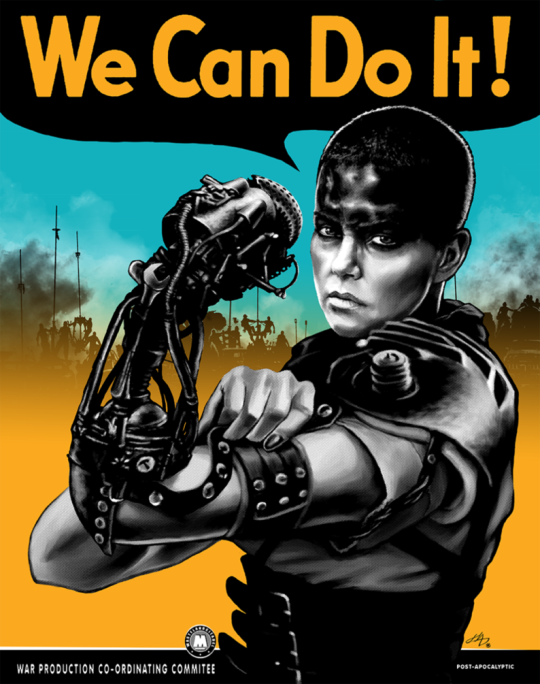
The character has already inspired an outpouring of fan art and cosplay. Even among movie fans who aren’t part of those scenes, people who love her REALLY love her. (And I wholeheartedly include myself in this category.) I can’t remember the last time that multiple, grown-ass adults on my Facebook feed had profile pictures referencing a movie character. Several of them–men and women–have this one:
Why has Furiosa inspired so much passion? I think a lot of it has to do with the way she blows a giant flaming hole in the standard images for women in action films.
While recent years have given us some fantastic action heroines, they tend to be confined within a few set tropes, with remarkably little variation.
Of course, by far the most common trope for women in action is still to be the person being rescued–to be the prize the protagonist, usually a man, gets at the end of the journey. There are whole franchises built around this concept. I think we can all agree that’s boring and not worthy of a blog post.
But even among women characters who have agency in action movies–as protagonists or as villains–there are still some basic patterns that recur again and again. In particular, there are three basic templates that a large majority of female action characters fall into. The point is not that these tropes, in and of themselves, are wrong. It’s that they’re often all there is.
1. The Girl Hero
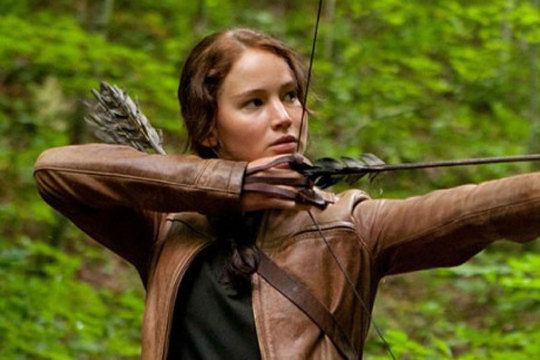
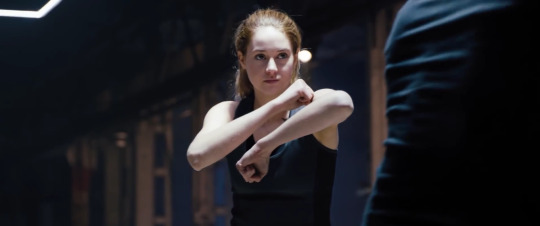
This is the default trope for YA. Katniss in The Hunger Games, Tris in Divergent…you’ve seen it many times.
Katniss Everdeen, The Hunger Games
The Girl Hero is virginal (often unusually non-sexual for a teenager). She’s usually small or skinny, sometimes for a logical reason (Katniss grew up starving), sometimes not so much. She seems like an underdog, but proves to be surprisingly good at violence and/or have some unique skill, and through her bravery and grit takes on foes much bigger than she is.
Tris, Divergent
It should be said that plenty of male YA characters share these characteristics–Harry Potter is also small and skinny, a novice in the world of magic, but unusually skilled at a few things. He doesn’t win his battles through physical strength, but through cleverness and bravery. And there’s an understandable appeal in having a scrawny underdog, of any gender, turn out to be a hero, especially in a book or movie geared toward young people. But with a few exceptions (see: Tamora Pierce) the Girl Hero with these qualities is THE template for young women in action/fantasy/sci-fi/speculative fiction, with not a lot of variation.
2. The Sexpot
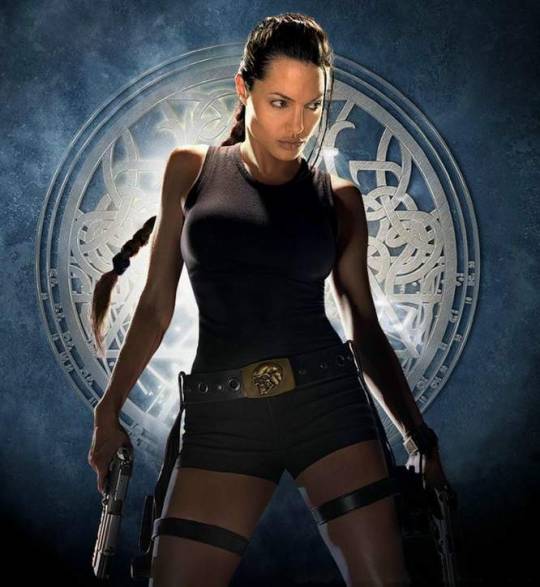
When the Girl Hero grows up, she can be properly objectified as a different trope, the Sexpot.
Lara Croft: poster girl for this trope
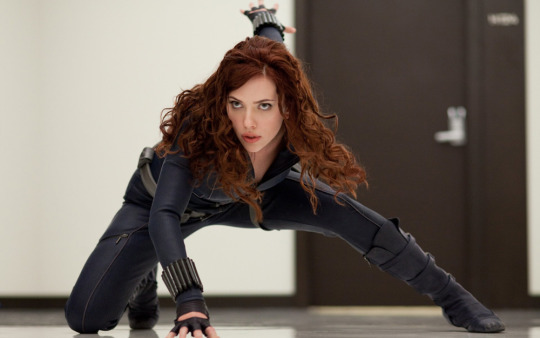
You’ve all seen this trope in the many, many superhero and comic book movies that are currently squirting out of the studio pipeline. She’s that one token woman on the team with four guys.
Yeah, that one.
The Sexpot gets to fight–and sometimes even gets artfully bloody and dirty–but she has to do it in a latex suit and while appearing cool and sleek and having a good hair day. (She has long hair, so she can flip it, and so we’re extra sure she’s a girl.) Her fight style is extra bendy and flippy and maybe when we break out the slow motion. She may use her sexiness as a weapon (a la Black Widow) or it may be just a bonus quality. She can be powerful, but only if we can look at her conventionally attractive body move around in tight clothing while it’s happening.
3. The Ice Queen
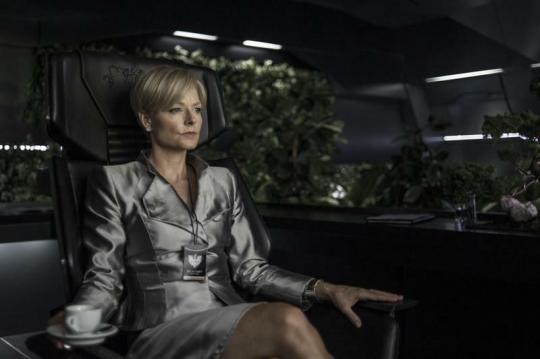
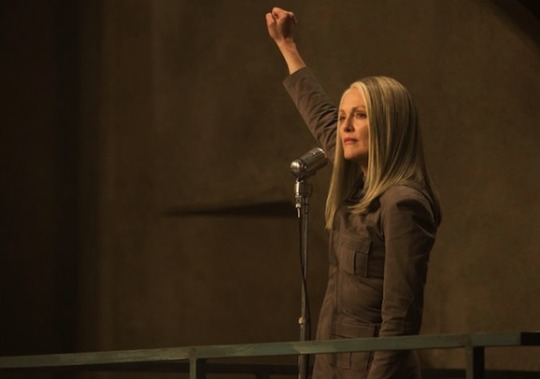
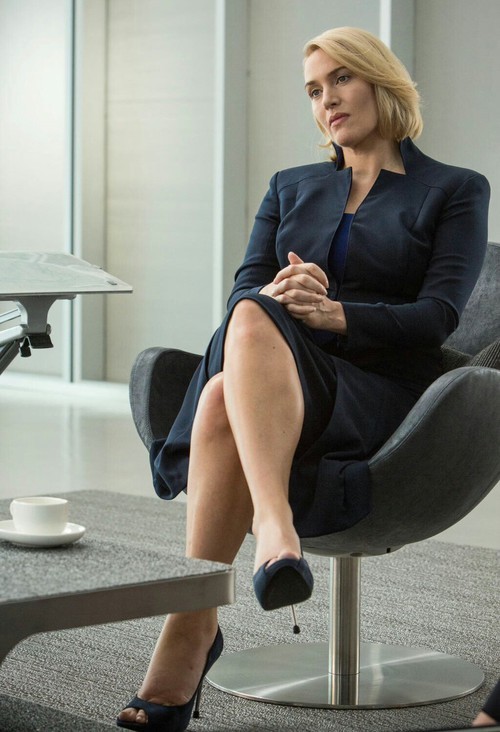
The Ice Queen is almost always the trope for female villains. She sits at the top of some kind of power structure–a state or a criminal enterprise–issuing commands to her minions but rarely doing the violence herself. She’s probably got a sharp suit or a uniform and a severe haircut.
Delacourt, the villain of Elysium.
She’s allowed to be older than 35.
President Coin, Mockingjay
The Ice Queen has institutional power but rarely fights; physicality is the low pursuit of men in her world. She may be smart, crafty and manipulative, but she will not punch you in the face. She’ll snap her fingers and get someone else to do it, although she may sit on the edge of her desk to watch.
Jeanine, the villain of Divergent
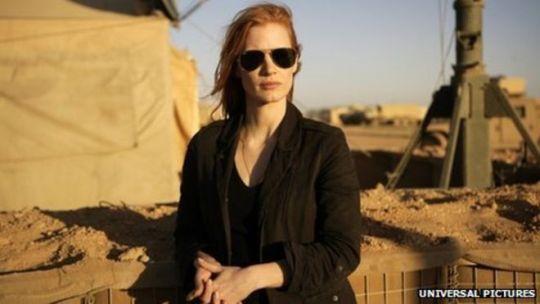
Maya, Zero Dark Thirty–an Ice Queen protagonist, sort of
The point here is not that there’s no variation on these themes. But it’s striking how often the women that do exist in the thriller, action, sci-fi and speculative fiction film universe fall into one of these three boxes. Which is why any character who doesn’t map onto one of these templates is so exciting.
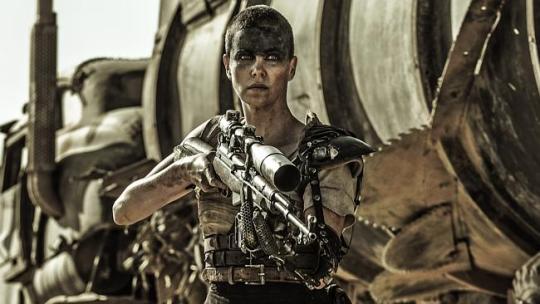
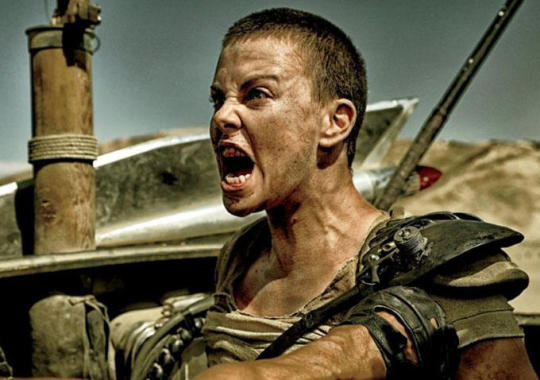
Here’s Furiosa.
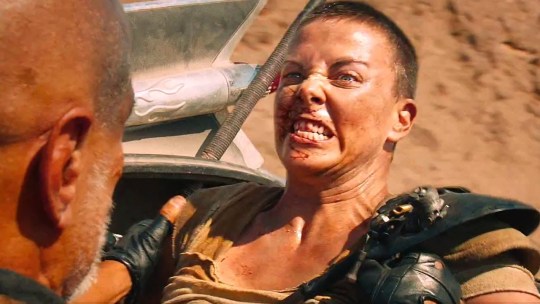
She fights a hell of a lot. She does not flip her hair.
She’s intensely physical, but you never get the sense that her fights are choreographed to perform her sexuality for you. They’re choreographed for her to fucking win.
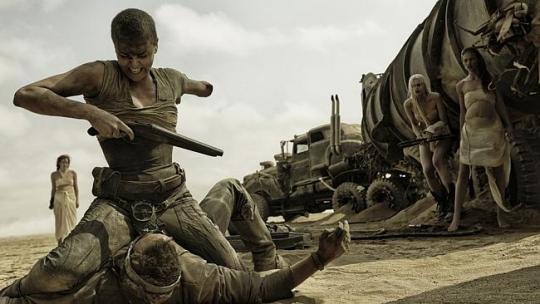
When Max shows up, they have a knock-down, drag-out fight with each other. Max doesn’t pull any punches. Why? Because he makes no assumptions that she’d be less lethal to him than a man. They beat the shit out of each other in a big, messy, grunty, scrabbly fight.
For significant portions of the movie, Furiosa is driving a truck, which means she’s essentially acting from the biceps up. You literally cannot look at her boobs. You have to look at her face.
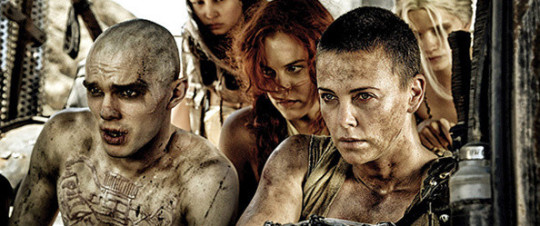
She gets to be dirty. Really really dirty. This picture alone highlights how weird it is that all the other women above are so clean.
She gets to be ugly and make weird faces in the middle of fighting.
She gets to yell and be angry the way one might be in the middle of a nonstop road battle when you’re full of adrenaline because you’re fighting for your life.
In short, she gets to look like an actual person who is actually fighting, instead of a statue that can do a back walkover with the help of a wire rig.
So it’s hardly surprising that she’s racked up a lot of fans. She takes all the images of clean, pretty, carefully sexualized women we’re used to seeing, even in action, rips them to shreds, sets them on fire and then drives over them with an 18-wheeler.
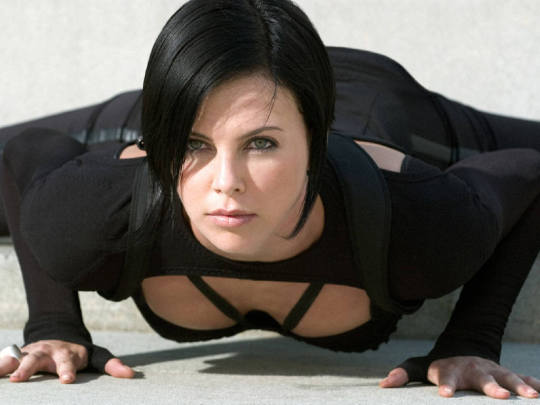
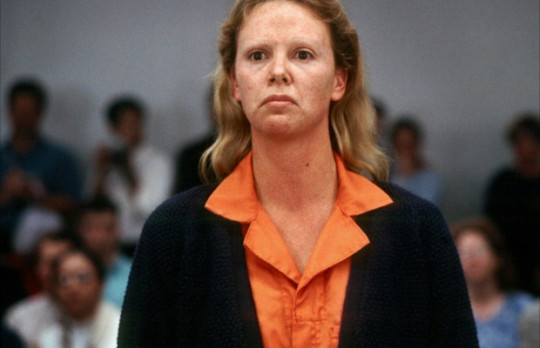
This is all even more remarkable given that Furiosa is played by an actress who is very feminine-presenting in her everyday life. Charlize Theron is one of the very few actress who’s been allowed to pick roles where she radically changes her gender presentation.
Here she is in Aeon Flux, playing about the most Sexpot-y character imaginable:
Here she is in Monster:
I think there are a lot more actresses out there who could take on these kinds of transformations, radically altering the way they look, move, and perform their gender, the way male stars do all the time. But the equivalent depth and diversity of roles for women just doesn’t exist in Hollywood right now.
Furiosa’s popularity shows how starved we are for images of women who are actually powerful and physical in the same ways that men get to be in blockbuster after blockbuster after blockbuster. It’s not that all the images of women in action have to look like this–it’s just that we hardly ever see a female fighter who looks this way. Furiosa reminds us that there is so much more out there than we’re getting in terms of what women can do and look like on screen.
I love everything about this analysis and it makes me reflect and realize this re how they present Furiosa:
From the very first shot of her all the way until her brawl with Max, we only see her face, her eyes in particular. The intensity in them is fucking breathtaking– haunting, scathing, lethal, broken, all at once. (A. O. Scott perfectly names it a “thousand-mile stare.”) So, absolutely, we don’t see her body, or anything distinctly female. There will be no gazes wandering to her chest or curves. We’re forced to look her in the eyes and accord her respect.
Posted on
The thing that people were chasing was to be not an object, but the five wives. I needed a warrior. But it couldn’t be a man taking five wives from another man. That’s an entirely different story. So everything grew out of that.
“Initially, there wasn’t a feminist agenda,” director George Miller insisted.
This quote about Mad Max: Fury Road made me want to gnaw on my own knuckle in cartoonish excitement because DO YOU SEE WHAT HIS LOGIC DOES THERE? Too many directors and writers would stop at “I needed a warrior.” They never take that next step to understand that it couldn’t be a man taking five wives from another man.
For most action movies, the first half of this quote is enough. It’s enough to be Liam Neeson or Jason Statham or Clive Owen as a good man rescuing the poor women from the bad man. Easy money, right? But Miller had the instinct to realize that a woman helping other women is not only a more interesting story to tell–it’s the story we should be telling all along.
Just because it’s a woman taking the five wives doesn’t make them LESS OF AN OBJECT, for fuck’s sake, they’re still being treated as property by the antagonist and the story still hinges on a hero rescuing people who were deemed unfit to rescue themselves.
NOOOOOOOO. No no no. Did you even watch the movie???? One of the first lines of the film is from the old woman at the Citadel. The woman says “She didn’t take them, they begged her to go!”
Later, it is again repeated that the plan to leave was Angharad’s master plan, and Furiosa was brought in as their instrument for escape. The Wives have agency since the very beginning of the film.
Like, compare with Max, who is literally unable to rescue himself (the best he managed is to keep from getting blown up before a sandstorm intervened).
Yes, they ARE being treated as property by the villain (I’m not going to call him the antagonist, because an antagonist is not necessarily evil, merely opposed to the goals of the hero).
The villain treats everyone as his property. That’s what makes him a villain, not just “the guy in charge who keeps everything running smoothly.”
Personally, I still think the movie would have not been essentially different if Furiosa had been a man – but obviously I have to bow at least somewhat to the thoughts and creative processes of the writer.
The wives couldn’t rescue themselves because they’d been kept in a harem for years. They’re tough women who do their best in every situation they’re in, they show tremendous courage, but they couldn’t rescue themselves because they were sheltered and didn’t have the survival skills. So, they asked for help. They show a solid motivation for their escape – to keep their kids from being raised by an abusive villain who treats other people as property (In many cases, a battered wife will only flee her husband when he starts threatening the children).
Not being able to do something is not the same thing as not having agency. Not knowing how to fight, how to survive, or what to do on the road doesn’t mean you don’t have agency.
I’d suggest that very few of the people reading this post would last five minutes on the Fury Road.