Just another WordPress site
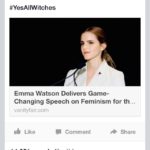
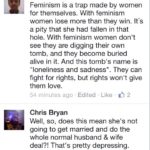
it’s exclusive to say leaders of feminism can only be marginalised: non-white, trans, lesbian etc. I’m not white and while I agree Emma isn’t THE representative of feminism, she can be ONE OF the representatives of feminism.
Not the same thing.
Also, I’ve seen some criticise Emma Watson because her speech gets more attention than others. You are criticising the wrong target. You should be criticising society and its inequalities that lead to the reason Emma gets more attention. Not so much Emma herself.
I do not want to be part of a kind of feminism that wants to exclude a big proportion of the world and say they cannot speak because they are too privileged. Because that is saying oppression is a contest and that only the people worse off should speak.That is wrong because then we are not using the standard of human rights and equality but the standard of oppression as a benchmark. Neither do we have the luxury to exclude people who have enormous soft power and ability to spread our message. I have a problem if the UN cancelled Malala’s speech so Emma could speak. It is fair to talk about representation. But I have no problem with what the UN did because that didn’t happen, and UN ambassadors haven’t just been white women like Emma Watson. Some others:
Waris Dirie- she’s a Somali supermodel. She is a UN ambassador against female genital mutilation- because she suffered it herself.
Or Aung San Suu Kyi? Activist for democracy who was under house arrest in Burma for decades before she was finally freed- UNAIDS ambassador for Zero Discrimination
Botswana model Mpule Kwelagobe, UNFPA ambassador
Princess Bajrakitiyabha Mahidol of Thailand, another UN Goodwill ambassador for women
And, of course, Malala Yousoufzai:
Do all these women have something in common, that the average woman being oppressed usually doesn’t have? Sure, they’re ambassadors because they’re all famous for various reasons and have escaped the circumstances where they were formerly oppressed in the case of Waris, Malala and Aung San Suu Kyi. Many of them are beautiful and comparatively more privileged than the people they advocate for. But them being famous is the entire point of UN Goodwill Ambassadors- to attract attention to a good cause. That’s how the world works, and the UN works within that reality- where there is no luxury to reject using high-profile people willing to use their soft power for good. And Emma was chosen precisely because she is that kind of person with enormous influence. I am not “white” and I am glad (glad, not bowing and scraping to her- just glad) Emma has decided to use her fame for this end- unlike what many other wealthy people choose to do.

My Least Favorite Trope (and this post will include spoilers for The Lego Movie, Guardians of the Galaxy, The Matrix, Western Civilization, and—cod help me—Bulletproof Monk*.) is the thing where there’s an awesome, smart, wonderful, powerful female character who by all rights ought to be the Chosen One and the hero of the movie, who is tasked with taking care of some generally ineffectual male character who is, for reasons of wish fulfillment, actually the person the film focuses on. She mentors him, she teaches him, and she inevitably becomes his girlfriend… and he gets the job she wanted: he gets to be the Chosen One even though she’s obviously far more qualified. And all he has to do to get it and deserve it is Man Up and Take Responsibility.
And that’s it. Every god-damned time. The mere fact of naming the films above and naming the trope gives away the entire plot and character arc of every single movie.
I have met some of the most amazing women I have ever known through the game industry. Larger-than-life, funny, warm, sweet, razor-sharp, overeducated women, the kind who laugh too loudly in quiet rooms. It’s been a long time since I’ve heard most of them laugh. One of them IMed me today about how she was leaving the industry and she couldn’t handle the idea of disappointing me but she just couldn’t take it any more, and I told her it was okay, it’s fine, self-care is so important, because it is.
The truth is that after our conversation ended, I put my head in my hands and cried.
I could tell you stories about the voices we’ve lost, the women we’ve scarred, the people we’ve left behind. I want to, but I’m not sure you’d get it. I tweeted earlier today, We should have a war memorial for all of the women we have lost to this. We should lay flowers and grieve and see our reflections in stone. And I meant it. I wish there were a way to honor the people our industry has wronged, and a way to visualize the enormity of what we have lost because of it— some representation of the gap between what games are and what they can be, and the pieces of the bridge between that have fallen away.