
Just another WordPress site






Johnlock: The Acting and What it Means for TJLC
Let me tell you a story. It’s about acting. It’s been told quite a lot, and the exact quotes change each time it gets told, but the punchline is always the same.
Dustin Hoffman and Sir Laurence Olivier are on the set of the Marathon Man. Hoffman’s character has stayed up three nights, so Hoffman walks onto the set after 3 days without sleep to be more realistic. Olivier, concerned, asks him why he looks so tired. Hoffman tells him. Olivier is very surprised. After a moment, he replies, “Try acting, dear boy…it’s much easier.”
What does this have to do with Johnlock? Everything.
…IT’S FULL OF
STARSQUOTES
I MUST SOURCE THEM
“There’s a great charge you get from playing him, because of the volume of words in your head and the speed of thought – you really have to make your connections incredibly fast. He is one step ahead of the audience, and of anyone around him with normal intellect. They can’t quite fathom where his leaps are taking him. Zip zip zip. But you catch me in the car on the way home after and I am, ‘Whoahhh!’” He does a theatrical wilt in his chair.“
(The Guardian interview with Benedict Cumberbatch, July 2010 [x])
“it doesn’t mean that I do a lot of good takes, it just means I like doing a lot of takes. And various rhythms come in with different characters and situations…it’s the 18th [take] sometimes. I can’t remember what my record is, it’s pretty heinous.”
(Benedict Cumberbatch: In Conversation for BAFTA New York, February 2014 [x])
"My default state is wariness.”
(Martin Freeman, The Daily Mail, November 2009 [x])
“Martin and I didn’t really know each other before Sherlock, but he walked into the audition and he raised my game.”
(Benedict Cumberbatch for What’s On TV, December 2013 [x])
“Martin did this amazing thing of having a military bearing. It’s something that’s in the [Conan Doyle] stories all the time. Sherlock’s always deducing things in the original stories based on people’s military bearing, and you think—‘What is that?’ Martin came in and did it—‘Oh look, he’s a soldier.’ He looks, he stands like a soldier. Everything about it worked.”
(Mark Gatiss, Sherlock: Anatomy of a Hit [x])
“I’ve got a pretty good musical ear and I can pick things up. But that wasn’t going to be good enough. I really wanted to do it justice. Not do it as a sketch: “Oh yah!” So I worked hard at it. I stayed in the accent all day on set. You’ve got to make it a habit, get that muscle memory.”
“I think acting is all about the other people. Sounds like a worthy thing to say but it’s true. I like the odd day on my own in the course of a film because you’ve got complete control and you can indulge yourself and all that sort of stuff. But the best work comes out of at least another person being in the room.”
(Martin Freeman, The Guardian April 2014 [x])


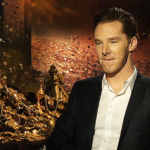
When I was about 25 years old, I worked with two very good actors. The encounters were brief, but I’ve remembered them both with great admiration. Wanda Ventham and Timothy Carlton both embodied qualities which one is fogyishly tempted to look at with nostalgia. Along with very considerable talent, they had elegance, glamor, wit, kindness and decency.
I didn’t know at the time that they were married or that they had a son of about 10 who was quietly gestating all the same attributes. And now, 30 years later, the boy has been let loose. He has taken the form of Benedict Cumberbatch.
His parents’ qualities are on rampant display. It’s rare to the point of outlandish to find so many variables in one actor, including features which ought to be incompatible: vulnerability, a sense of danger, a clear intellect, honesty, courage — and a rather alarming energy. I take no pleasure in feeling humbled, but there’s no getting around it.
He must be stopped.