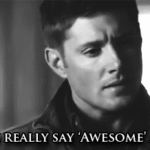
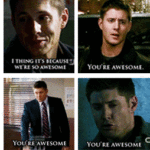
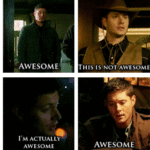
JESUS FUCKING CHRIST I’M NOT EVEN IN THIS FANDOM AND OMG
i’m cry iNG
OHMYGOD. The Smack It! page! *cackles*
why does this keep getting note
OMFG
I’M CRYING.
HAS ANYONE TWEETED HIM YET BECAUSE HE WOULD LOVE THIS
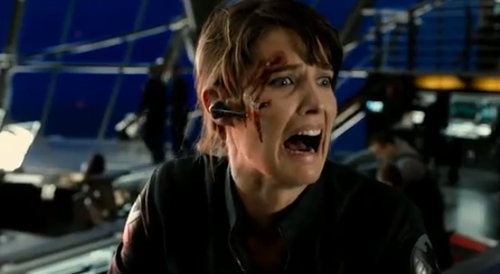
I think I just died.

Just another WordPress site
JESUS FUCKING CHRIST I’M NOT EVEN IN THIS FANDOM AND OMG
i’m cry iNG
OHMYGOD. The Smack It! page! *cackles*
why does this keep getting note
OMFG
I’M CRYING.
HAS ANYONE TWEETED HIM YET BECAUSE HE WOULD LOVE THIS
I think I just died.

I also think the role of the assistant has changed since Steven Moffat started overseeing Doctor Who. Rose, Martha and Donna were chosen to travel with the Doctor because they showed in one way or another that they were smart and up to the challenge. Amy and Clara both come to the Doctor first and foremost as mysteries. Amy is the little girl who grew up with a rift in time in her bedroom wall, who doesn’t know why she doesn’t have parents. She spends many episodes being mystically both pregnant and not pregnant but doesn’t know a thing about it and all our information about it comes through the Doctor. What the fuck is that?
Some version of Clara dies on screen twice before she is taken on as the assistant, and it seems like the Doctor takes up with her to find out why. In both cases, the woman is not of interest for her character or her abilities, but for some fundamental mystery in her being. The mystery isn’t even a secret she’s keeping, something over which she has control- it’s something she does not know about, that the Doctor must puzzle out in his own mind. It’s not about her- it’s about what’s wrong with her. When Steven Moffat took over Doctor Who, women became a problem.
What is wrong with Doctor Who? (via zelda-fistgerald)
Things about New!Who that I couldn’t explain why felt wrong.
(via bloggingthetrench)
Interesting.
This is actually really interesting.
I love that he pointed out that it’s different when men and women are objectified on film, not only because of the way our society views men and women, but also in the specific way those shots are framed.
When consuming media it’s so important to remember that filmmakers and ad companies have so many tools at their disposal that the average viewer is not even aware of. The way a scene is set, the way the camera moves, which parts of a person are included in the fame, the number of seconds the camera views each particular part of a person. All of these things very subtly evoke responses from us. We don’t notice them because we aren’t supposed to notice them—if they are doing their job right, everything feels seamless and correct to the viewer. And even if we do notice, we may not be able to articulate it because most of us haven’t studied filmmaking techniques.
If you think you are 100% impenetrable to the effects of the content you view, you are deluding yourself.
Interesting.
This is actually really interesting.
I love that he pointed out that it’s different when men and women are objectified on film, not only because of the way our society views men and women, but also in the specific way those shots are framed.
When consuming media it’s so important to remember that filmmakers and ad companies have so many tools at their disposal that the average viewer is not even aware of. The way a scene is set, the way the camera moves, which parts of a person are included in the fame, the number of seconds the camera views each particular part of a person. All of these things very subtly evoke responses from us. We don’t notice them because we aren’t supposed to notice them—if they are doing their job right, everything feels seamless and correct to the viewer. And even if we do notice, we may not be able to articulate it because most of us haven’t studied filmmaking techniques.
If you think you are 100% impenetrable to the effects of the content you view, you are deluding yourself.