Today is the first day of Early Voting for Texas, so I went to do so.
There was a LINE
it took me 30 minutes to vote
I have NEVER seen this happen during early voting
Makes me cautiously hopeful

Just another WordPress site
Today is the first day of Early Voting for Texas, so I went to do so.
There was a LINE
it took me 30 minutes to vote
I have NEVER seen this happen during early voting
Makes me cautiously hopeful
lifeandlovesofemmalinethewriter:
I feel like when you’re writing, organizing chapters and dialogue is easy
but jfc, the amount of time it takes to constantly keep people moving and make sure they’re in the right spaces and trying to come up with wording for it is always such a shock.
Like, fuck, I made you pick up a coffee cup, you need to put it down at some point. also I can’t remember what I dressed you in, can you push up your sleeves? I don’t remember if you even have your shirt on.
and YOU. YOU OVER THERE, you got out of your chair earlier, but did you come back yet? Are you coming back? Where did you even go and why’d you get up? Fuck, I can’t make you sit down again already, you just stood up, go…over there. go get more coffee. Did you bring your mug with you? fine. bring the pot to the table and—wait, wasn’t the coffee pot already over here? shit, hold on, I need to go back and re-read and re-write
this is the most relevant thing i have ever read.
I think one of the most wild things as a writer is the sensation that you’re not actually directing your characters– they’re sort of directing themselves, and you’re scrambling around attempting to copy down whatever it was that they just did, but they don’t wait for you to finish copying. They just keep walking and talking and moving around and existing of their own volition and at some point you look up and you’re like “WHOA OKAY EVERYBODY BACK THE FUCK UP WHERE ARE WE”
It’s kind of like trying to write sheet music for an orchestra while it’s playing
#thatwritinglife
It’s kind of like trying to write sheet music for an orchestra while it’s playing
Oh my god its in words
“Listen,” my main character says reasonably, “I’m not just gonna sit still while he goes on spouting that nonsense.”
I, the writer, frantically scribble down a rough map and route. “No, obvious now, but I still have to write the part where he yells–”
“I’M BEING IGNORED,” the antagonist yells and begins to flap his arms. “LOOK I AM ALSO DYNAMIC.”
“Whoa there,” the main character says mildly and begins to do squats. They pull out a weapon. “Take a look at this escalation!”
“No!” I cry, “he took your gun, like, five minutes ago–”
“Second gun,” the main character says and cocks it. Pauses. “Was I on a low squat or a high one just now?”
“HOW LONG HAVE I BEEN BLOWING RASPBERRIES?” the antagonist wants to know, still spinning.
“When did you start spinning?” I ask in despair.
There is no escape.
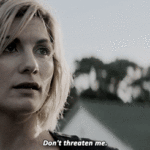








Am I rewatching the new Doctor Who ep for the third time today? PERHAPS.
But one of the things that stands out to me so much about this episode is that it washes away a lot of the things that made me frustrated about the Moffat era.
- The plot MAKES SENSE. I feel like I could use this ep to introduce anyone to Doctor Who and it would make sense. It’s not concerned with being THE MOST “CLEVER” THING ON TV. It’s not concerned with twists and turns and surprises that aren’t earned just to prove how clever the writers are.
- It’s fun. It’s legitimately fun.
- The new companions? There doesn’t seem to be a big mystery about them (*cough*Clara*cough*River*cough*) They seem like normal people who were just in the right/wrong place at the right/wrong time. GIVE ME MORE OF ANYONE CAN BE HEROIC INSTEAD OF ONLY THE *SPECIAL* TRAVEL WITH THE DOCTOR. Let me see myself in them cause I’m not special, but I bet I could be if I got to travel with her.
- Showing that the Doctor is brilliant and clever and quick instead of just telling and telling and telling me.
- All the companions get to use their knowledge to help the Doctor. And it’s not magic knowledge, it’s things like bus drivers and police work and social media.
- The Doctor never pulls a ‘no I have to go alone’ bullshit – everyone’s like ‘how do we help?’ and she’s all ‘C’MON FAM WE’RE GOING TO FIX THIS TOGETHER’.
I just really like this season already, okay?
There are moments in a rock star’s life that define who he is. Where there was no darkness, there was no you. And it’s going to be a wild ride.
— Rocketman (2019) dir. Dexter Fletcher








Nearly all teachers I worked with habitually excuse Hitler
As an assistant teacher for 16 years, I encountered numerous examples of antisemitism being taught — sometimes unknowingly — in England’s classrooms. Nearly all of the teachers I encountered had uncritically absorbed antisemitic tropes at their universities and teacher training colleges, much of it dressed up as “anti-Zionism”.
For instance, Year Sevens are taught about the Black Death in RE, a lesson I often observed. Children were nearly always told that the Jews were blamed at the time for the plague, but this was rarely presented as an example of an antisemitic falsehood. Indeed, the teachers usually left open the question of whether the Jews really were responsible.
That meant that when the children were taught about the Holocaust in Year Nine, it was not uncommon for children to respond by saying, “But Sir! The Jews DID give us the Plague though… ‘coz you said so in Year Seven!”
For instance, Year Nines are often taught about the Holocaust in the context of why the Jews have been hated throughout history. But unless carefully presented, this “context” can often seem like an apology for Nazism, as if the Jews did something to deserve their misfortune.
Nearly all the teachers I have worked with who were born in the 1980s habitually excuse Hitler and undermine the unique historical horror of the Holocaust. The usual response to Hitler’s genocidal antisemitism is to explain that it was not just the Jews. Others suffered too. In the interests of “balance”, the teachers often point out that Hitler did good things as well as bad — he created jobs and made Germany great again, for instance.
When I suggested to a teacher that we first talk about the positive influences of Judaism before introducing the Holocaust, she dismissed it on the grounds that “learning how successful they are might irritate some people”.
In GCSE History, antisemitism often slithers into students’ subconscious in ramshackle debates about the aftermath of the First World War. “You can understand why the German people were so angry with the Jews after the First World War, because if you fought in the trenches, lost your jobs and your businesses and you saw that the Jews were having an easier time of it, you’d be angry too,” explained one teacher, helpfully.
Because, of course, German Jews did not fight in the trenches, German Jews did not lose their savings, their jobs and their businesses. So, all Jews are cowards, all Jews are rich, all Jews have no right to get angry.
Visiting a school as a guest speaker once, I tried to explain to some teachers in the staff room how ridiculous Jewish stereotypes were. They immediately launched into a tirade about the “arrogant Jewish princesses” they had encountered growing up who got everything they wanted on “Daddy’s money”. A self-professed ‘lefty’ even complained that a street near her university was “wall to wall Jewish businesses”. One of these teachers boasted to me that she had taught the whole Holocaust ‘module’ without showing “one of those atrocity pictures once”. When I relayed this to a Jewish friend whose mother survived Ravensbruck, he said, “How can people know how bad it was without showing them how bad it was?” This same teacher, who claimed the Holocaust was “absolutely fascinating”, whispered to me, “we have to ask this question” and, instead of saying it aloud, wrote it down on her planner and showed it to me: Did they deserve it?
I was shocked. Do we ask this question about the Middle Passage? Do we ask it about the victims of 9/11? We do not. Incidentally, she had already taught her students about Israel and why its existence was so “controversial” and, as she explained to me, that’s why the desert question had to be asked. In her brain, the Holocaust and Israel had somehow become chronologically juxtaposed, with the foundation of the state of Israel in 1948 somehow causing the murder of six million Jews by the Nazis.
Alas, this kind of prejudice is not confined to the state sector. A young acquaintance of mine who attends a posh private school told me his history teacher joked that “Jews won’t fight” after he was asked if Jews had fought in the First World War. I armed the pupil with facts: the Roman Legion Regi Emeseni Iudeai; Cleopatra’s two generals; how, in the First World War, Jews were the largest ethnic group to fight for either side; how Anne Frank’s father, as well as the young lieutenant who awarded Hitler his Iron Cross, had fought for Germany. The boy told the class, the teacher smirked and said, “Well, you learn something new every day.” Maybe so, but very rarely do you learn anything about antisemitism from teachers.