


Holmesosexuality: On Mark Gatiss’s Camp
Mark Gatiss’s gay Sherlock characters and scenarios in The Great Game (in particular) are an emotional homage to Billy Wilder’s film, The Private Life of Sherlock Holmes. This is a film that Gatiss (an out and proudly married gay man) credits with changing his life and claims that it was a template of sorts for him and Moffat as they conceived of Sherlock.
Gatiss’s version of Sherlock and John’s relationship mirrors what Gatiss reads in TPLoSH— that Sherlock falls in love with John gradually over the course of their relationship.
The relationship between Sherlock and Watson is treated beautifully; Sherlock effectively falls in love with him in the film, but it’s so desperately unspoken. -Gatiss on TPLoSH (x)
I can’t help but see this scene from Sherlock when I think of Gatiss’s comment about TPLoSH.
Holmes’s unspoken tenderness in TPLoSH is complicated. There are two conversations about homosexuality going on simultaneously in the film: the overtly gay campy performances and plot line; and the hints that Holmes’s erotic attachments are to his own sex, hints that are only expressible because of the situations engendered by campy plot.
There’s an amazing scene [in TPLoSH] where, to get out of a situation where a Russian ballerina wants Sherlock to father her child, he claims Watson and he are gay. Watson is outraged and, when he calms down, speaks of the women all over the world who could attest to his sexuality. He says to Sherlock, “You do too, don’t you?” Holmes is silent, and Watson says, “Am I being presumptuous? There have been women, haven’t there?” Holmes says, “The answer is yes – you are being presumptuous.” Sensational. -Gatiss on TPLoSH (x)
Humor is what Holmes has. Humor protects him. Innuendo says so much and nothing at all. Gatiss uses it masterfully in the pool scene.
Glad No-one Saw That
Parallel this scene from TPLoSH to the “glad-no-one-saw-that” pool scene where all Sherlock can utter is that thing that John did was good. Sherlock can’t express in any clearer terms (until Hounds, Gatiss’s next script) his emotions over John’s willingness to sacrifice his life and what the kind of love they share means. John diffuses the poolside tension with a lame joke about sex— the “you-ripping-my-clothes-off” and “people-will-talk” bit. Note the grin on Sherlock’s face when he says that people do little else. You get the sense that Sherlock likes the idea. The fact is that people DID see it— we, the audience, saw it (and possibly the snipers and Moriarty we can imagine). The performance was both visible and utterly private— mocking, overt sexual expressions with a genuine unspoken erotic subtext.
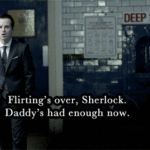
But this tender dialog and demonstration of loyalty, love, and vulnerability can only arise between Sherlock and John because of the roles they play in Moriarty’s campy theatrical. He’s the first of them to give voice to the gay subtext overtly when he scolds Sherlock that “daddy’s had enough now.” (Daddy is a term overtly dripping with campy gay signification.) And it’s Moriarty who breaks the spell of the desire expressed but not said. The sexual tension between John and Sherlock cannot linger too long. Moriarty is a better joker. He’s soooooo changeable and he and Sherlock to have a “special something” between them to attend to.
Notes on Camp
There are so many definitions of “camp” that it can be confusing. What most people can agree on is that it’s a sensibility that’s got to do with homosexuality, love, and performance. Here are two useful attempts at defining this sensibility. The first expresses so aptly Gatiss’s approach to Sherlock:
“You can’t camp about something you don’t take seriously. You’re not making fun of it; you’re making fun out of it. You’re expressing what’s basically serious to you in terms of fun and artifice and elegance.”
– Christopher Isherwood, The World in the Evening (1954)and
In American writer Susan Sontag’s 1964 essay “Notes on ‘Camp’”, Sontag emphasized artifice, frivolity, naïve middle-class pretentiousness and shocking excess as key elements of camp.
Sontag cites Tchaikovsky’s ballet Swan Lake as a prime example of camp. And it’s Swan Lake that leads to the campy gay antics of TPLoSH.
As Gatiss said. SENSATIONAL!
Really well put. Bravo.

