
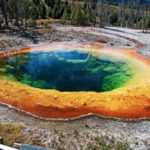
do you ever just stop and think wow what the fuck these things are real and they exist in the world like what this shit ain’t just a picture it is actually literally a thing somewhere
Yeah this is in Yellowstone national park man. It’s good, you should go sometime.
I’ve been here and it smells really bad
but it look cool doe
Fun fact about these pools: the bluer the color the hotter it is. The red rim is the coolest part and the blue is the hottest. (THIS DOES NOT MEAN YOU SHOULD TOUCH THE RED RIM IT IS STILL SCALDING HOT)
It’s the same with fire. The red/yellow flames are the coldest while the white/blue are the hottest – but I wouldn’t advise you to touch either 🙂
Actually, Yellowstone is a massive volcano, which is why the hot springs exist. If it erupts (which its due to anytime in the next millennia), I will be in the immediate blast zone, a 10 hour drive away (through Wyoming, which pretty much does not have speed limits). However, the resulting ash cloud/destruction of life etc. will effectively wipe out life on earth.
And thousands of tourists flock there.
I don’t know, there is something beautiful in dangerous things, y’know?if the Yellowstone super volcano erupted the entire continent of North America would be immediately fucked and the rest of the world would be fucked very soon after
this is alarming and terrifying to me
You can relax – a little bit.
It is completely not true that a Yellowstone supereruption would “wipe out life on Earth.”
Here’s what would actually happen:
There would be ashfall across most of the country. It would be significant within 205 miles of the eruption site. Significant, meaning a meter or so of ash. For the rest of us, it would be anywhere from a few millimeters to a few centimeters.
The heavy ashfall might cause building collapses, bury cars, etc. The ash might cause breathing problems, especially in people already susceptible to such. There may be loss of power due to ash shorting out transformers. Light ash fall would make driving challenging (as in, you’d have to be careful, as if driving on ice or snow).
Air travel would be completely curtailed until the eruption was over and the ashfall had settled – much like when that eruption in Iceland canceled flights all over Europe.
There would be damage to crops in the midwest resulting in higher prices and possibly food shortages.
The climate would be temporarily cooled. The worst case scenario? A short term ice age.
And all of this is worst case. This is modeling the worst possible scenario.
Would it be horribly devastating bad? Yes. People would die. People would go hungry. The economy would hit rock bottom. We’d probably have a second Great Depression. What happened at the time of the first? The dust bowl. That’s the same level of disaster.
Would it wipe out all life on the planet? No.
The chance of an eruption like this this century? Well under 1 percent. An asteroid strike is more likely.
What’s much more likely is that Yellowstone will continue to have minor earthquakes and small eruptions until the hot spot moves far enough away from the existing crust weakness that it “fades.” The spot would then create a new crust weakness…and a new “Yellowstone” in, oh, a million years or so.
So. Please try not to worry about it. (Oh, and if it did go, we’d get plenty of warning – enough to get out of the immediate danger zone).
Ah yes. I love disaster science.