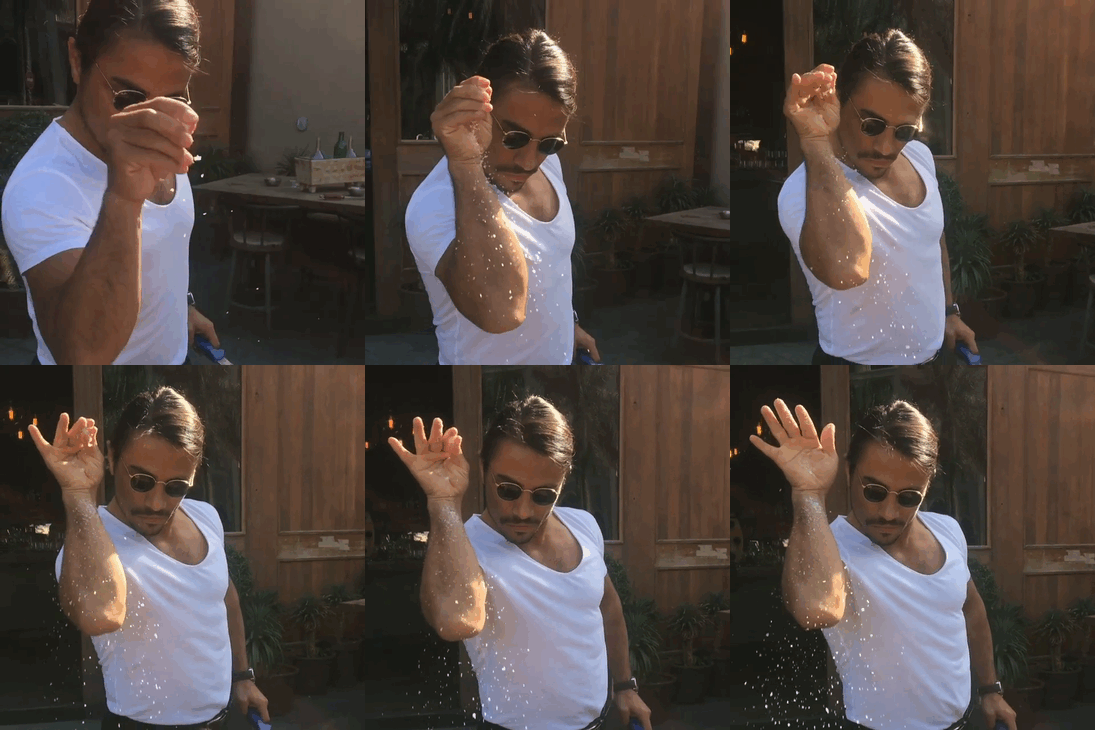
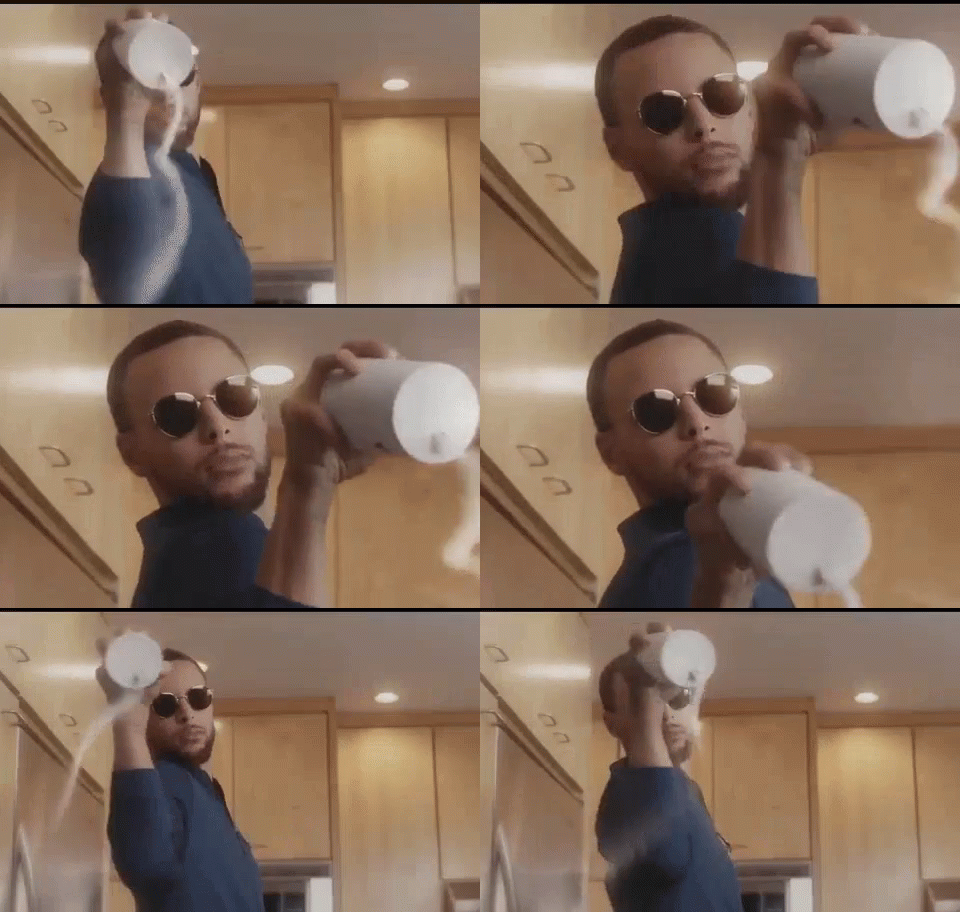
Me: *listening to The Magnus Archives, a creepypasta podcast, on my bluetooth headphones*
Podcast: *has just gotten to the part where our hero, alone in the labyrinthine tunnels under his workplace where his predecessor was murdered, realizes he doesn’t know how long his flashlight batteries will last*
Literally the Podcast: I began to wonder how much battery I had in my torch. I had put a fresh one in before my expedition; I’m not stupid. But the more I thought about it, the more I realized that I don’t actually know how long batteries last for continuous use in a –
My headphones, at top volume: YOUR BATTERY IS LOW.
Everyone who says “it’s not in the interest of corporations to harm workers and customers” hasn’t heard of history or cost benefit analysis. Mass industrial slaughter (companies letting workers die because it’s more expensive to enforce safety standards) has killed thousands. The collapse of the Rana Plaza is an example, and Grenfell tower.
triangle shirtwaist factory as well
also: the sampoong department store collapse, where 502 people were killed. the building was known to be unsafe since its construction and structural cracks were noted several times without any response. the building was assessed by civil engineers as a collapse risk. the day of the collapse, “the store management failed to shut the building down or issue formal evacuation orders, as the number of customers in the building was unusually high, and it did not want to lose the day’s revenue.” executives, however, had evacuated hours before.
the bhopal disaster had an immediate death toll of 2,259 and an estimated 16,000 people have died since. over 550,000 people were exposed to a toxic gas leak from a pesticide plant when the leak spilled into shanty towns surrounding the plant. there had been smaller leaks for nearly 10 years before the disaster, each of which killed or severely injured workers who were not provided with protective gear. during the major leak, all safeguards against a disaster of this scale either hadn’t been maintained and weren’t working, were inadequate for a spill of this scale, or had been removed years before.
the big blue crane collapse killed 3 ironworkers who were nearby in an observation basket, because higher-ups refused to stop work on the construction of miller park stadium due to unsafe wind levels for crane operation. the original crane operator had refused to do it, so another was brought in. a safety inspector happened to be on site and filmed the incident to document a violation when the crane collapsed entirely. this video has been shown in every OSHA class i’ve ever taken as proof of why 1) safety inspectors aren’t your enemy, no matter how much your boss tries to tell you they are 2) bosses can and will put your life at risk to avoid losing money 3) even if you’re not directly involved in the safety violation–the crane operator survived, but the three ironworkers in the basket were killed when the crane fell on them–your life can be at risk.
there are many, many more of these. more than i can count. and the thing is, these are all just worst-case situations where higher-ups thought they could skate past safety regulations and save a few bucks (or even make a few bucks) without consequences. many of these unsafe conditions went on for years before ending in disaster. the people in sampoong and rana plaza worked in those dangerously structurally unsound building for years before they collapsed, generating money for bosses and executives when no one should have even stepped into those buildings at all. many places are currently skating by and flouting safety regulations, and all of them are living on borrowed time before a disaster strikes.
It’s not in the long-term interest of corporations to harm workers and customers, but the people who run these things tend to toss long-term out the window in favor of short-term gains that they can cash in immediately.
As a whole, humans fucking suck at conceptualizing long term risks and odds. We’re really good at “it’s been okay so far, what’s one more day?” day after day after day. That’s why we write out objective (as much as possible) safety standards because just because you’ve done it before and haven’t died doesn’t mean it isn’t still an unsafe practice.
When you are writing a story and refer to a character by a physical trait, occupation, age, or any other attribute, rather than that character’s name, you are bringing the reader’s attention to that particular attribute. That can be used quite effectively to help your reader to focus on key details with just a few words. However, if the fact that the character is “the blond,” “the magician,” “the older woman,” etc. is not relevant to that moment in the story, this will only distract the reader from the purpose of the scene.
If your only reason for referring to a character this way is to avoid using his or her name or a pronoun too much, don’t do it. You’re fixing a problem that actually isn’t one. Just go ahead and use the name or pronoun again. It’ll be good.
Someone finally spelled out the REASON for using epithets, and the reasons NOT to.
In addition to that:
If the character you are referring to in such a way is THE VIEWPOINT CHARACTER, likewise, don’t do it. I.e. if you’re writing in third person but the narration is through their eyes, or what is also called “third person deep POV”. If the narration is filtered through the character’s perception, then a very external, impersonal description will be jarring. It’s the same, and just as bad, as writing “My bright blue eyes returned his gaze” in first person.
Furthermore,
if the story is actually told through the eyes of one particular viewpoint character even though it’s in the third person, and in their voice, as is very often the case, then you shouldn’t refer to the characters in ways that character wouldn’t.
In other words, if the third-person narrator is Harry Potter, when Dumbledore appears, it says “Dumbledore appears”, not “Albus appears”. Bucky Barnes would think of Steve Rogers as “Steve”, where another character might think of him as “Cap”. Chekov might think of Kirk as “the captain”, but Bones thinks of him as “Jim”.
Now, there are real situations where you, I, or anybody might think of another person as “the other man”, “the taller man”, or “the doctor”: usually when you don’t know their names, like when there are two tap-dancers and a ballerina in a routine and one of the men lifts the ballerina and then she reaches out and grabs the other man’s hand; or when there was a group of people talking at the hospital and they all worked there, but the doctor was the one who told them what to do. These are all perfectly natural and normal. Similarly, sometimes I think of my GP as “the doctor” even though I know her name, or one of my coworkers as “the taller man” even though I know his. But I definitely never think of my long-term life partner as “the green-eyed woman” or one of my best friends as “the taller person” or anything like that. It’s not a sensible adjective for your brain to choose in that situation – it’s too impersonal for someone you’re so intimately acquainted with. Also, even if someone was having a one night stand or a drunken hookup with a stranger, they probably wouldn’t think of that person as “the other man”: you only think of ‘other’ when you’re distinguishing two things and you don’t have to go to any special effort to distinguish your partner from yourself to yourself.
This is something that I pretty consistently have to advise for those I beta edit for. (It doesn’t help that I relied on epithets a lot in the earlier sections of my main fic because I was getting into the swing of things.) I am reblogging this so fanfic writers can use this as a reference.
A good rule of thumb: a character’s familiarity with another character decreases the need for an epithet (and most times you really don’t need one at all).
Good writing advice.
I think there does come a point when a character’s familiarity actually wraps around and does make epithets relevant again, and it’s when referring to a relationship. (I remember in a short story that I’ve otherwise entirely forgotten, a ~modern~ woman saying that she had her nephew call her by her first name, and the POV character thinking how sad it was to put the distance of a name between family members–and there’s something to that.)
Most of the time when I’m writing a character interacting with their parent or grandparent, the parent isn’t referred to by name in narration–because most characters don’t think of parents and grandparents by their first name–but as “his mother” or “his father” or “her mom” or “her dad”–and this can be used to very compactly convey information about the nature of the relationship, because there’s a big difference between “my Grandmother Hardison” and “my Nana” or between “the Count my father” and “my Da.”
And if the character is a different kind of family member–a sibling, a child, a spouse–then the moments when a character thinks not of “Erik” but “his cousin,” not of Thor but “his brother,” can be used for great effect. The author just needs to be aware of when they’re particularly highlighting the relationship and when that’s not what they need to draw attention to.
The most rad thing about Sherlock fandom is there’s any sub genre that you could want.
Sherlock as an artist? Done.
Johnlock on a fucking merchant vessel in the 1800’s? Cha-ching.
John is a catcher (🙃) and Sherlock as a pitcher (😏)? Giddy up.
Bookshop owner? Yeppp.
Sherlock’s a florist? They’re fish? They hike in the Pacific Northwest? Butler and gardner and balletlock and tunalock, greaserlock, vampirelock and fucking Odamaki and blueink3 and clones and ghosts and actors and Victor Trevor and text relationships and threesomes and so many safe words.
There’s tattoolock and that one coffee shop AU that just won’t quit, fireplace hearth sex, risking their lives in the Alps, being hermits in Canada.
Can’t forget reality show chef and country and western recluse, Wimbledon, the surfing classsssic, omegaverse and parentlock.
There are careful and thoughtful takes on characters’ identities. There are gentle interpretations on aging. There is illness and death and birth, deep explorations of humanity and love and hate.
Every reality you would like to see brought to life, any trope you could want, every scenario you could imagine given eagerly to you by a *range* of people from seasoned creators to first-time writers.
The breadth and sheer volume of fan fiction is amazing. The fact that we have so many insanely-talented creators giving us quality content is ridiculous.
You’re all so fucking cool. Thank you for creating. Thank you for being brave and sharing your work and treating these characters so lovingly.