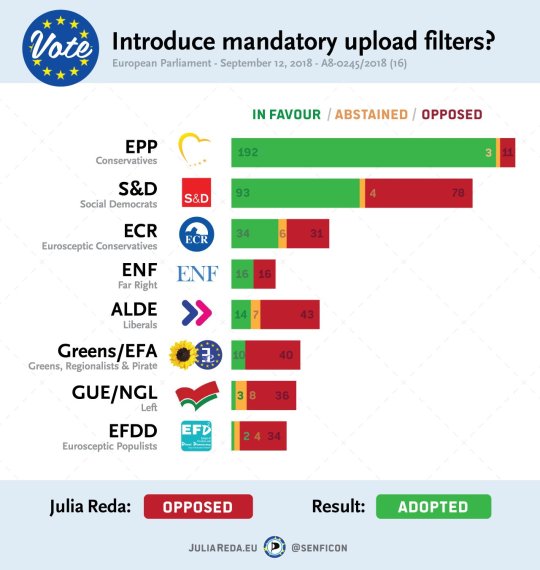
Lobbyists for “creators” threw their lot in with the giant entertainment
companies and the newspaper proprietors and managed to pass the new EU
Copyright Directive by a hair’s-breadth this morning, in an act of
colossal malpractice to harm to working artists will only be exceeded by
the harm to everyone who uses the internet for everything else.
Here’s what the EU voted in favour of this morning:
* Upload filters: Everything you post, from short text snippets to
stills, audio, video, code, etc will be surveilled by copyright bots run
by the big platforms. They’ll compare your posts to databases of
“copyrighted works” that will be compiled by allowing anyone to claim
copyright on anything, uploading thousands of works at a time. Anything
that appears to match the “copyright database” is blocked on sight, and
you have to beg the platform’s human moderators to review your case to
get your work reinstated.
* Link taxes: You can’t link to a news story if your link text includes more than a single word
from the article’s headline. The platform you’re using has to buy a
license from the news site, and news sites can refuse licenses, giving
them the right to choose who can criticise and debate the news.
* Sports monopolies: You can’t post any photos or videos from sports
events – not a selfie, not a short snippet of a great goal. Only the
“organisers” of events have that right. Upload filters will block any
attempt to violate the rule.
Here’s what they voted against:
* “Right of panorama”: the right to post photos of public places despite
the presence of copyrighted works like stock arts in advertisements,
public statuary, or t-shirts bearing copyrighted images. Even the
facades of buildings need to be cleared with their architects (not with the owners of the buildings).
* User generated content exemption: the right to use small excerpt from
works to make memes and other
critical/transformative/parodical/satirical works.
Having passed the EU Parliament, this will now be revised in secret,
closed-door meetings with national governments (“the trilogues”) and
then voted again next spring, and then go to the national governments
for implementation in law before 2021. These all represent chances to
revise the law, but they will be much harder than this fight
was. We can also expect lawsuits in the European high courts over these
rules: spying on everyone just isn’t legal under European law, even if
you’re doing it to “defend copyright.”
In the meantime, what a disaster for creators. Not only will be we liable to having our independently produced materials arbitrarily censored by overactive filters,
but we won’t be able to get them unstuck without the help of big
entertainment companies. These companies will not be gentle in wielding
their new coercive power over us (entertainment revenues are up, but the share going to creators is down:
if you think this is unrelated to the fact that there are only four or
five major companies in each entertainment sector, you understand nothing about economics).
But of course, only an infinitesimal fraction of the material on the
platforms is entertainment related. Your birthday wishes and funeral
announcements, little league pictures and political arguments, wedding
videos and online educational materials are also going to be
filtered by these black-box algorithms, and you’re going to have to get
in line with all the other suckers for attention from a human moderator
at one of the platforms to plead your case.
The entertainment industry figures who said that universal surveillance
and algorithmic censorship were necessary for the continuation of
copyright have done more to discredit copyright than all the pirate
sites on the internet combined. People like their TV, but they use their
internet for so much more.
It’s like the right-wing politicians who spent 40 years describing
roads, firefighting, health care, education and Social Security as
“socialism,” and thereby created a generation of people who don’t
understand why they wouldn’t be socialists, then. The copyright
extremists have told us that internet freedom is the same thing as
piracy. A generation of proud, self-identified pirates can’t be far
behind. When you make copyright infringement into a political act, a
blow for freedom, you sign your own artistic death-warrant.
This idiocy was only possible because:
* No one involved understands the internet: they assume that because
their Facebook photos auto-tag with their friends’ names, that someone
can filter all the photos ever taken and determine which ones violate
copyright;
* They tied mass surveillance to transferring a few mil from Big Tech to
the newspaper shareholders, guaranteeing wall-to-wall positive coverage
(I’m especially ashamed that journalists supported this lunacy – we
know you love free expression, folks, we just wish you’d share);
What comes next? Well, the best hope is probably a combination of a
court challenge, along with making this an election issue for the 2019
EU elections. No MEP is going to campaign for re-election by saying “I
did this amazing copyright thing!” From experience, I can tell you that no one cares what their lawmakers are doing with copyright.
On the other hand, there are tens of millions of voters who will vote
against a candidate who “broke the internet.” Not breaking the internet
is very important to voters, and the wider populace has proven
itself to be very good at absorbing abstract technical concepts when
they’re tied to broken internets (87% of Americans have a) heard of Net
Neutrality and; b) support it).
I was once involved in a big policy fight where one of the stakes was
the possibility that broadcast TV watchers would have to buy a small
device to continue watching TV. Politicians were terrified of
this proposition: they knew that the same old people who vote like crazy
also watch a lot of TV and wouldn’t look favourably on anyone who
messed with it.
We’re approaching that point with the internet. The danger of internet
regulation is that every problem involves the internet and every poorly
thought-through “solution” ripples out through the internet, creating
mass collateral damage; the power of internet regulation is that every
day, more people are invested in not breaking the internet, for their
own concrete, personal, vital reasons.
This isn’t a fight we’ll ever win. The internet is the nervous system of
this century, tying together everything we do. It’s an irresistible
target for bullies, censors and well-intentioned fools. Even if the EU
had voted the other way this morning, we’d still be fighting tomorrow,
because there will never be a moment at which some half-bright, fully
dangerous policy entrepreneur isn’t proposing some absurd way of solving
their parochial problem with a solution that will adversely affect
billions of internet users around the world.
This is a fight we commit ourselves to. Today, we suffered a terrible,
crushing blow. Our next move is to explain to the people who suffer as a
result of the entertainment industry’s depraved indifference to the
consequences of their stupid ideas how they got into this situation, and
get them into the streets, into the polling booths, and into the fight.
Furious about this vote. I foresee a lot of leaning on my MEPs in the near future. And further.
Damn it all!
This is a scary time to be using the internet, but also remember this:
The coding of this will be MONUMENTAL. It will take SO much money to do and implement that if we can hang on and fight for a year, most politicians will see how actually doing this, and make it work in any sensible way, would be a colossal cost to governments.
So its gonna be a rough few years ahead, but rest assured, if we keep complaining and lobbying + can keep our heads up above the flood of bad coding to come, we’ll stand victorious.
And also, I can tell you, Finland and Sweden both pretty much said NO to this en-mass, therefore its not like there isn’t opposition to this from whole countries.
Do not lose hope. We have a way out and there are politicians fighting against this out there!
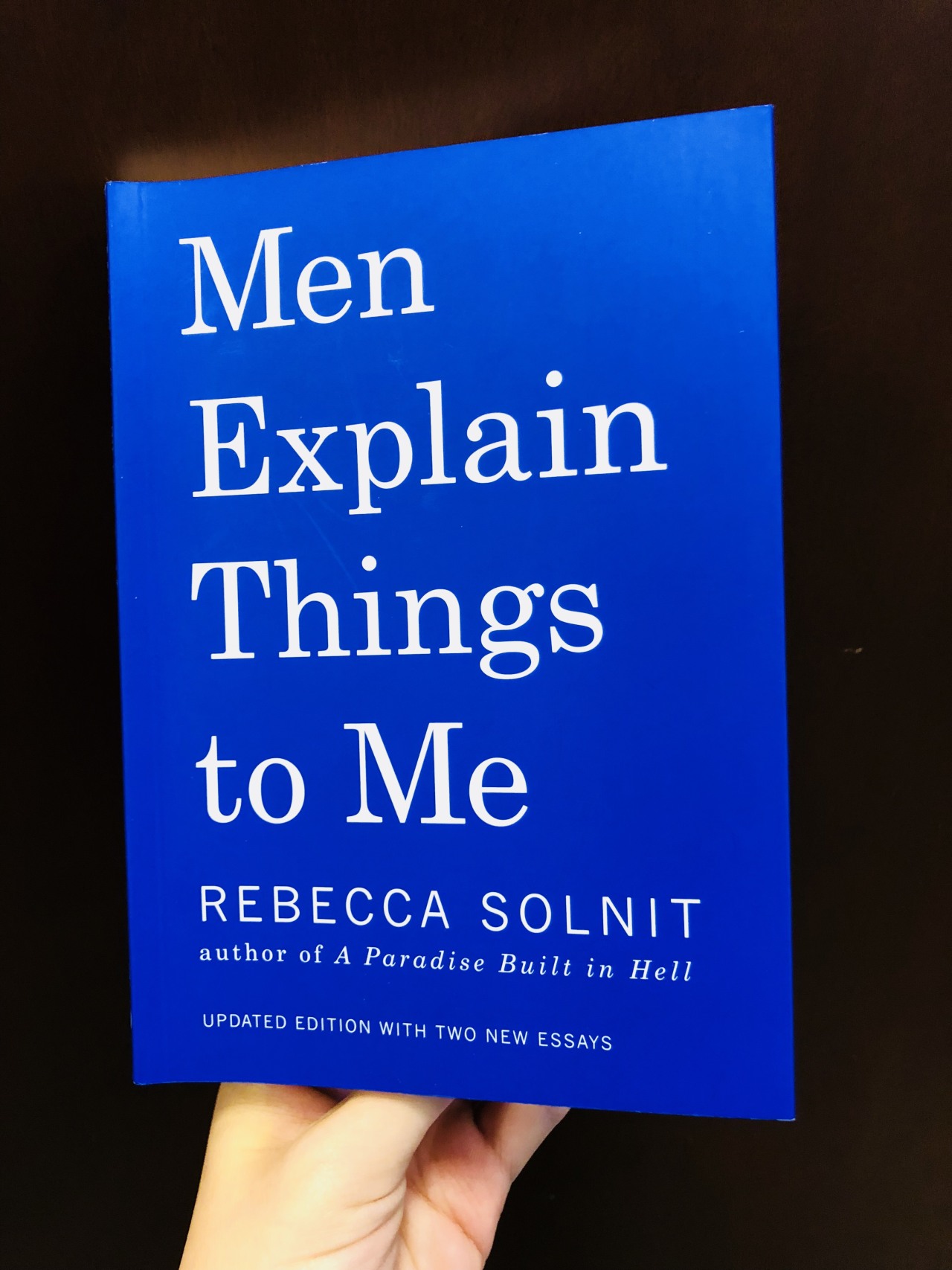
Men Explain Things to Me – a collection of essays worth reading!
Rebecca Solnit’s scathing but insightful collection of essays left me with a lot to think about. Throughout the book, she provided several fascinating points about the oppression of women in our modern-day society.
She first discussed the origin of the word mansplaning – how men take advantage of women by their words, an established power move. Then, she moved on to more serious ideas – that there is a consistent problem of violence of men against women in society. She used an example of a sexual assault by the head of a powerful government organization to show that the entire power system of the world is skewed. In fact, the struggles of disadvantaged countries reflect those of women. Is this a coincidence? I think not.
She questions our society’s ideals, like those of traditional marriage. The model of marriage puts the man in power, making the husband controls wife. The wife is almost made into a possession, while the man is the owner. Marriage equality is is where two people who love each other have the same rights and power. Contemporary marriage should be a partnership more than a conquering. Another societal ideal is how society has made women disappear – through family trees, names, and even physical confinement. When we tell girls to stay in, we do not question the men who make them do so.
Solnit begins to bring up a solution. Virginia Woolf, one of the first feminists, talked about embracing the darkness, or the unknown. She urged us to push forward for women’s liberation, so far that it is dangerous… a kind of limitless freedom. After all, women do not have credibility when it comes to their own experiences. Men will put them down because they are female. We must make the credibility for ourselves.
Now, feminists are rewriting the story! Women are uniting using the hashtag #yesallwomen to speak out against male oppression. Young feminists, the heart of the movement, are dreaming bigger and bolder, becoming scientists and leaders. Ultimately, the idea that women deserve the same rights as men has been already put out there, and more ideas will continue to shape the women’s rights movement more than we can imagine.
She said this in the context of how incels basically form parasocial death cults when they are ‘blackpilled.’ They come to believe that because they feel terrible about themselves right now, that feeling is objectively true and forever, and even the reality of how the ‘world really works’ and there’s no hope to change it, only to “LDR”. Which is, ‘lie down and rot’, a form of suicide baiting. What’s happened here is that otherwise genuine feelings of pain or insecurity have been validated maybe too much and have evolved into an entire worldview centered around affirmation of pain. And once pain-as-truth becomes social capital, the way people behave changes to maximize its growth and spread.
But I have to say? I feel like I have encountered versions of the very same behavior in my own spaces, on tumblr, on facebook, etc.:
There’s definitely forms of love-bombing that surround mental illness or depression support connections that shower you with confirmation and praise only as long as you reject any steps of managing mental illness, so long as it unstoppably dominates your life. Once you question someone else’s behavior or declare that you’re seeing a therapist or something all your new parasocial friends turn against you.
I’ve seen it in supposedly feminist spaces where women that are otherwise strangers to each other talk each other into hopelessness and heightened fear of sex and fear of other people in their life, especially male figures. Sometimes not even based in a specific personal experience, but instead just this collective ‘dark truth’ of womanhood. TERFs love to do this, and segue younger people into fear of trans women this way.
I’ve seen it happen a lot within lgbt+ spaces where someone’s personal despair about dysphoria, homophobia they face, not being able to find a partner or being judged by family or strangers, or even fear of violence, enters a feedback loop with other people they don’t actually know and don’t have any interests but their own consumption in mind amplifying it, forming these insular enclaves where fear is truth and everyone else is wrong because they don’t feel as terrible about being attracted to the same sex or for being trans as they should. Meanwhile no one struggling within this structure is actually getting the support or help they need, they’re just arguing about it and building cases for, when the mythical support does fall from the sky, why they should get it first.
There’s mounds of discourse where people argue over how because that group couldn’t possibly live as terrible a reality as this group, their lived experience isn’t the order of the universe and therefore doesn’t deserve validity or attention at all. And to argue, inexperienced people fall into the trap of trying to artificially match the despair levels of their critics, or try to counter one black pill with their own black pill which will never be credible to outsiders, resulting in cringy disaster at all vectors. In the red-hot radioactive mess troll accounts prosper.
Which is not to say that all these situations are full of people as baseless as incels– some of them are living very difficult lives, but are using “masochistic epistemology“ as the internal logic of their world. And the effect of such an internal logic is extremely dark self-confirming biases in excess of what is necessary to communicate the dangers of their lives, or cope with hardship. And any similar person who goes off seeking friends who acknowledge their pain is going to find a black hole of people who’d otherwise be peers escalating that very pain in themselves and others in order to confirm it’s all real.
Natalie Wynn herself, a trans woman, struggled with the urge to go to 4chan’s /lgbt/ and wait for the most toxic and hopeless crowds there rip her appearance apart even though it made very little logical sense. The people there shared the same insecurities as her, that they don’t pass, that people will despise them, and in some way hearing those insecurities confirmed rather than denied to her felt more like ‘the real truth’ or ‘what people really think’ than it did to hear praise and encouragement. Even if what they had to say wasn’t anywhere near an objective truth.
The “pain is real” mindset is that hard to shake! It doesn’t matter if you’re smart, prepared to identify the phenomenon with philosophy education, intellectually aware that it’s bad for you. There is a self-harm impulse to ‘face reality’, but a very specific reality that confirms the bias of your pain or insecurity. The comfort zone of discomfort, in a way! It just wants you to not feel crazy for feeling those things and is willing to hurt you even more to prove you’re right about your environment or your life.
When I’m at my sickest, I feel like my pain is objectively true in a way nothing else is. The people who love me are lying or duped by my manipulative nature, the hope I had was false and I never should have tried, etc.
Online communities of a certain kind of political bent really encourage this—present the idea that there’s a way the world is, and that way is not just unfair and unjust sometimes but endlessly destructive. People on the right and the left do this.