It’s called Centralia, Pennsylvania, and while not what inspired the games it is the place that inspired the setting for the films and they share quite a few similarities.
Centralia is a near-ghost town in Columbia County, Pennsylvania. Its population has dwindled from over 1,000 residents in 1981 to 10 as of 2010, as a result of the Centralia mine fire burning beneath the town since 1962. All properties in the town were claimed under eminent domain by the Commonwealth of Pennsylvania in 1992 (and all buildings condemned), and Centralia’s ZIP code revoked by the Postal Service. State and local officials reached an agreement with the remaining residents allowing them to live out their lives there, after which the rights of their properties will be taken.
Graffiti on highway entering the town.
A lonely house standing in Centralia
Very few homes remain standing in Centralia. Most of the abandoned buildings have been demolished by the Columbia County Redevelopment Authority or reclaimed by nature. At a glance, the area now appears to be a field with many paved streets running through it. Some areas are being filled with new-growth forest.
The remaining church in the town, St. Mary’s, holds weekly services on Sunday and has not yet been directly affected by the fire. The town’s four cemeteries, including one on the hilltop that has smoke rising around and out of it, are maintained in good condition. It is estimated that the amount of coal located around and under Centralia will sustain the fire for at least 250 years.
One of the remaining graveyards
St. Mary’s Church
Centralia has been used as a model for many different ghost towns and physical manifestations of Hell. Examples include Dean Koontz’s Strange Highways and David Wellington’s Vampire Zero, and, as stated, the film adaptation of Silent Hill.
Broken road releasing smoke
Knoebels Amusement Resort, in nearby Elysburg, features The Black Diamond, a dark ride/roller coaster based on the theme of a haunted coal mine. Near the end of the ride, trains pass a swirling, fiery vortex. Although this resembles popular depictions of the gates of hell, a sign identifies the location as Centralia.
Part of The Black Diamond Ride
With such a history it wouldn’t be surprising if their were some spirits lingering in the town still. It is a great site for a horror movie and isn’t surprising it has been used as a inspiration multiple times. I would love to visit this place one day.
Centrailia before the fire.
If your interested in finding out more about the history of the town, here is well done documentary you might enjoy.
The trap of the two-woman love triangle is not one that Hamilton entirely avoids. Angelica and Eliza fall neatly into the old conventional/rebellious dichotomy. Angelica, who stands center stage as she raps, “I’ve been reading Common Sense by Thomas Paine / So men say that I’m intense or I’m insane,” is the rebellious one. Eliza, who has, she tells us, “never been the type to try and grab the spotlight,” is the conventionally feminine one. And because Angelica and Eliza are the only major female characters in the show — Peggy Schuyler and Maria Reynolds, the other two female singing parts, have one song apiece — they stand in for all women. Angelica is not just an intellectual woman in the way that Hamilton and Jefferson are intellectual men; she is the intellectual woman. Eliza is not just a domestic woman but the domestic woman.
But Hamilton does depart from the typical love triangle structure when it comes time to designate one of the women as good and the other as bad. The show has no interest in doing so, and it can be shocking to realize this. Watching Hamilton for the first time it is easy to anticipate, as Als does in his New Yorker review, that because Eliza is “genteel” she must be “therefore dull,” or that because Angelica is politically intelligent she must be angry and shrill, as Noonan is pleasantly surprised to find she is not. Instead, Hamilton treats both its women with respect and admiration. It operates on the assumption that both of these characters are important, that the different ways they perform femininity are valid, and that their contributions to history are valuable.
*What makes Hamilton unique is that it recognizes the tragedy in both women’s lives*
Hamilton recognizes that in the 18th century, both rebellious and conventionally feminine women are trapped. Angelica has the intellect and the drive to make valuable contributions to the emerging republic, but instead she is stuck behind the scenes, “a girl in a world in which / my only job is to marry rich.” Her refrain throughout the show is, “I will never be satisfied,” because it is her tragedy to live in a world where she cannot do the kind of work that would satisfy her. In contrast, Eliza has the opportunity and means to do the kind of domestic work that she loves and is good at, but she lives in a world where this kind of work is not valued, because it’s considered less important than the political work Hamilton does. Eliza is stuck at the fringes of history, whispering, “Oh, let me be a part of the narrative,” and her refrain is, “That would be enough,” because it is her tragedy to live in a world where she is denied the little respect she asks for.
And Hamilton gives both Angelica and Eliza the space onstage to examine their tragedies. Angelica’s “Satisfied” is widely considered to be one of the best songs in the show — Rolling Stone calls it Hamilton’s “finest moment” — and the musical ends with Eliza in the spotlight and center stage, declaring, “I put myself back in the narrative.” In the world of Hamilton, Angelica’s plight is worth more musical attention than the Federalist Papers; Eliza’s domestic work and contributions to history are so important they become the focus of the finale. Neither of the two women is “bad” or “lesser.”
There’s a moment at the beginning of “My Shot,” the third song in Hamilton, when our protagonist spells out his name in triumphant defiance of the odds against him: “A-L, E-X, A-N-D / E-R / we are / meant to be.”
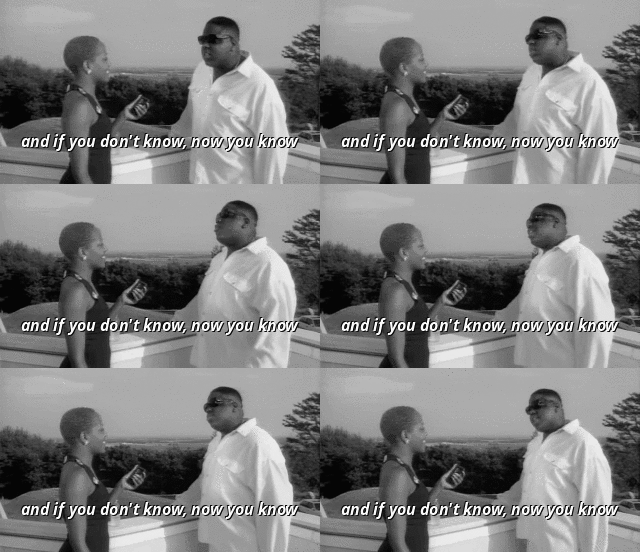
The first time I heard it, my head snapped, because I recognized the callout immediately. He’s imitating Biggie in “Going Back To Cali”: “Imma spell my name one more time, check it / It’s the, N-O, T-O, R-I, O / U-S / you just / lay down / slow.”
That’s when I was like, oh yes, it is on. Much of the brilliance of Hamilton is in how Lin-Manuel Miranda manages to incorporate every musical style from Sondheim to pop to R&B to create something totally new and infectious (he raps a reference to Gilbert & Sullivan for god’s sake). This piece called Miranda a “human iPod shuffle” and it’s hard to disagree. He elevates American art forms like jazz, musical theater and rap to tell the story of a bunch of old white dudes in the 18th century and makes it downright riveting.
But it’s the hip hop references that really make the show sing.
There’s no way I could go through all of them, but let’s just look at one song as a dope example: “Cabinet Battle #1.” First of all, you’d never know you needed a rap battle between Jefferson and Hamilton in your life until you hear this, and then you’re like, goddamit how did I live without it? A rap battle is, at its heart, a tennis match of wits and verbal one-upsmanship. It’s the perfect frame for something that could be incredibly boring: a debate over policy. And what a debate it is. So let’s go through some of my favorite callbacks, shall we?
The song opens with George Washington–who is officiating the battle, natch–welcoming the crowd: “Ladies and gentleman, you could have been anywhere else in the world tonight, but you’re here with us in New York City!” Sound familiar? It’s borrowed, both in words and delivery, from Jay’s intro to “Izzo” on The Blueprint: “Thanks for coming out tonight, you could have been anywhere in the world, but you’re here with me.” 🙌 🙌 🙌
OK, this is sort of an aside, but it’s too good to not mention. Even though Thomas Jefferson is basically a dick, his swagger is on point, as evidenced by Daveed Diggs’ smug growl on “These are wise words / enterprising men quote em / don’t act surprised you guys / cuz I wrote em.” I need Daveed Diggs to marry me just for that. Oh, and the “yawww” at the end of the line? Totally Drake.
Jefferson doesn’t let up: “Oh, if the shoe fits wear it! / New York’s in debt, why should Virginia bear it?” Umm…that’s an allusion to Eminem’s verse on the Jay/Em joint “Renegade”: “If the shoe fits, I’ll wear it / But if it don’t, then y’all’ll swallow the truth, grin and bear it.”
And then Jefferson takes it all the way back to the godfather of modern hip hop: “Such a blunder, sometimes it makes me wonder why I even bring the thunder” is a direct shout to Grandmaster Flash’s “The Message.” Don’t forget the throat-clearing “aha-ha-ha-ha.”
And that’s not even getting into the devastating lyrics (if I was in the crowd when Hamilton raps “Yeah, keep ranting / We know who’s really doing the planting” I would have been on. the. floor.).
I know I’ve been raving about Hamilton since NPR first streamed the soundtrack two weeks ago, so I figured I owed it to you guys to explain a tiny bit of why it has me enraptured. Best of all, the whole soundtrack is so densely packed, you discover new layers upon every listen. So what are you waiting for?
(also referenced in “Cabinet Battle #2; Miranda sure loves Biggie)