
I wanted to post that for Valentine’s Day, but I couldn’t wait, so have some nb peeps & queer ladies of color with their loved ones. ♥
It’s finally the day. HAPPY VALENTINE’S DAY ♥
Thirty years ago, reeling from the Reagan Revolution, elite Democrats rebranded their party, which had long championed both economic and cultural liberalism. They kept cultural liberalism, but ditched economic liberalism for “neoliberalism”; a blend of economic deregulation, free trade, smaller government and targeted tax cuts. Few said it out loud, but it was the end of the Roosevelt coalition, which had been built on economic issues of universal appeal and which had lasted 50 years.
Neoliberalism appeals to the rich. Neoliberal Bill Clinton was the first Democratic presidential nominee to outspend a Republican. In 2008 Obama outspent John McCain 2-to-1, breaking a record set in 1972 by Richard Nixon. But neoliberalism is killing the middle class. It’s why both parties rely on cultural issues to hold their bases. If you back abortion rights, same sex marriage and gun safety you’re a Democrat. If not, you’re a Republican. On economic issues it’s more complex. If you hate big banks and political corruption, you could be for Sanders or Trump. It’s why Sanders talks so much about these things; they’re what the election’s all about.
When Clinton isn’t calling Sanders a traitor, she says she shares his goals. But she doesn’t. Clinton was part of the neoliberal revolt that destroyed the Roosevelt coalition and she is as we’ve seen, a woman of markedly fixed views. She may be Obama’s heir, but Sanders is FDR’s. She campaigns as she does out of habit, and to hide the very real choice. The neoliberal experiment is over. Democrats, proud heirs to Franklin Roosevelt, are ready to come home.
Stevie Wonder is presenting at the Grammys tonight and when he opened the envelope, he showed it to everyone and yelled “HA HA NONE OF YOU CAN READ BRAILLE.” After the laughter died down, and before he announced the winner, he said, “I do want to say that…we all need to make every single thing accessible to everybody who has a disability.”
At the Grammys.
Which has a worldwide audience of tens of millions.








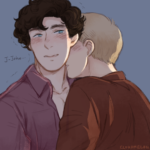

Hamlet is a polyamous bisexual, Horatio is a demiromantic ace, and Laertes is gay and you’ll never convince me I’m wrong.

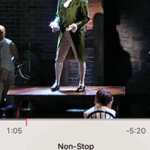
It was Amber White’s second day as a stage manager on “Hamilton,” and Lin-Manuel Miranda, the show’s creator and star, was sick.
Viewers who buy their tickets months in advance are never happy to hear about a substitution. This was Broadway’s hottest show, based on a brick of a book by historian Ron Chernow, a fresh depiction of the New Yorker who fathered the American banking system, endured a sex scandal, and died in a duel. This was the first time that Miranda or Javier Muñoz, who plays the role on Sundays, didn’t appear as the title character. The role went to Jon Rua, the understudy, making his debut as America’s ten-dollar founding father.
White and the production team called an emergency rehearsal — 30 minutes long — for which the cast came to the theater. And then the show went on: “flawlessly,” White said, thanks to Rua but also the professionalism of the rest of the cast and crew.
White, 36, is one of the crew members in the room where it happens for eight shows a week, critical to the musical’s success but largely unseen.
Stage managers, three of whom work at a time on “Hamilton,” are the guardians and protectors of the show and the cast — “a cross between a flight attendant and a mom,” White says — who tend to the mental and psychological well-being of the actors.
They are also often with the show long-term, from pre-production meetings on design and concept through to rehearsals, previews and performances, taking care of the practicalities of scheduling and organization. And, always, troubleshooting.
During a recent production of “Hamilton,” an ensemble member hurt his neck with about 35 minutes left in the show.
Coming off stage, squeezing past barrels of prop rifles and shelves of neatly stored mugs, he went to the stage managers’ office to find White. The actor said he couldn’t go back on.
Quickly, White paged one of the swings — an understudy ready to fill in for multiple roles at a moment’s notice — upstairs in his dressing room. She and the other stage managers coordinated the switch, getting the swing into costume and microphone and on stage in time for his new character’s next appearance. The hurt actor went home.
The show went on. The audience never noticed. Crisis averted.
Backstage at Hamilton, the show that blew us all away
(am New York)Heads up on Avengers Academy: the game is made by TinyCo, who will put out a fun game for about 6 months then completely try to bleed their customers dry. More and more things become premium only, and they’ll leave freemium players hanging with nothing to do for months on end. Lots of things and no land to put them on. I’m not saying you shouldn’t play and have fun, just be careful; there are balanced freemium games out there and based on my experience with their other games, TinyCo’s aren’t.
Yeah, I figured there’d be a point where you’d have to pay or gtfo. Loki’s Frost Giant outfit costs more shards than I will ever see 😀 I do appreciate the warning.
On the other hand, that’s the nice thing about the game being set in a canon that we (as the canon’s fandom) are familiar with – when the game gets too expensive we’ll just run off and toy with gifs and fics forever. The game is just foundation for us. I mean, none of us are playing because we love the game mechanics or the challenges, because it’s really just time management and point-and-click. I feel pretty confident saying that most fans playing this game are either in it to unlock a favorite character or for the weird, freaky worldbuilding it’s doing.
I mean I want to know what’s going on with the timefog as much as the next person, but it’s not like this game is high narrative quality or something; if I don’t find out via the game, someone’ll put it on a wiki sooner or later, which will almost amount to the same thing. And in the meantime I can always write fanfic about it for free.
Fandom is the great leveler of capitalism: whatever your product, whatever your narrative, whatever price you’re charging, we will find a way to surround it with vast, enticing fields of free content. (And porn.)