



Portuguese history meme — seven places/buildings [7/7]
Monastery of Alcobaça
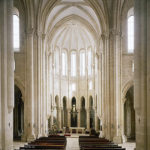
The Alcobaça Monastery is a medieval Roman Catholic monastery located in the town of Alcobaça, north of Lisbon. It is one of the first foundations of the Cistercian Order in Portugal. It was founded in 1153 as a gift to Bernard of Clairvaux, shortly before his death, from the first Portuguese King, Afonso Henriques, to commemorate his victory over the Moors at Santarém in March 1147. The foundation of the monastery was part of the strategy by Afonso Henriques to consolidate his authority in the new kingdom and promote the colonisation of areas recently taken from Moorish hands during the Reconquista.
The church and monastery were the first truly Gothic buildings in Portugal. Due to its artistic and historical importance, it was listed by UNESCO as a World Heritage Site in 1989. Today, it is one of the main historic tourist destinations in Portugal.
During the Middle Ages, the monastery quickly became an important and powerful presence in Portugal. The monastery owned and developed extensive agriculture areas, and the abbot exerted influence over a large area. It had an important library, and a public school was opened in 1269. The last touch in the medieval ensemble was given in the late 13th century, when King Dinis I ordered the construction of the Gothic cloister, the Cloister of Silence.
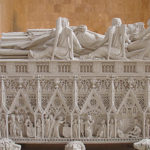
The importance of the monastery can be measured by the fact that many royals were buried here in the 13th and 14th centuries. Kings Afonso II, Afonso III, and their Queens Urraca of Castile and Beatriz of Castile are buried here, as well as King Pedro I and his mistress, Inés de Castro, who was murdered on the orders of Pedro’s father, King Afonso IV. After being crowned King, Pedro commissioned two magnificent Gothic tombs for him and for Inés, both of which can still be seen inside the monastery church, facing each other. The stylistic quality of the sculptured ornaments, even with the restoration needed after Napoleon’s troops mutilated them in 1810-11, is surpassed by the compelling symbolism of the iconography which evokes human destiny, death and the Christian hope of eternal life. Built around 1360, the tombs are the tangible sign of Pedro I’s mystical rehabilitation of Inés.
During the reign of Manuel I, a second floor was added to the cloister and a new sacristy was built, following the characteristic Portuguese late Gothic known as “Manueline”. The monastery was further enlarged in the 18th century, with the addition of a new cloister and towers to the church, although the medieval structure was mostly preserved. In the Baroque period, the monks were famous for their clay sculptures, many of them are still inside the monastery. Elaborate tiles and altarpieces completed the decoration of the church.
The great 1755 Lisbon Earthquake did not cause significant damage to the monastery, although part of the sacristy and some smaller buildings were destroyed. Greater damage was caused by invading French troops in the early 1800s. In addition to looting the library, they robbed the tombs, and stole and burnt part of the inner decoration of the church. In 1834, with the dissolution of monastic life in Portugal, the last monks were ordered to leave the monastery. The remnants of the monastery library, including hundreds of medieval manuscripts, are kept today in the National Library in Lisbon.